




What a hard start on a rooftop unit means for your business
The call usually starts the same way. The rooftop unit hums, clicks, and quits, or the breaker trips again after someone has already reset it once. Inside, the space warms fast, because a commercial building carries more square footage and more equipment heat load per ton than a house, and a warehouse floor or a retail space without cooling on a summer afternoon turns into a decision about sending customers or staff home. Some of these calls come in as commercial hvac down with the whole building affected, and others come in as one zone running warm while the rest of the building holds steady, which points at a different fault than a unit that will not start at all.
Most of what gets called an emergency commercial ac repair is not a dead compressor on the first attempt. The run capacitor gives the compressor and the condenser fan the extra push they need to start spinning, and once that capacitor weakens, the motor pulls far more current trying to start than it ever does once it is running. Waco keeps these units under near constant load for months once summer sets in, and that runtime is what wears out a capacitor long before it wears out the compressor sitting behind it. A rooftop unit that hums and quits in July is more often a capacitor and a contactor than a failed compressor, which is why the amp reading gets taken before anything gets replaced on an emergency rooftop unit repair call.
The pattern gets worse the longer it runs unchecked. A weak run capacitor lets the compressor try to start without enough torque, so it pulls high amps on every attempt instead of settling into its normal running current. Each failed start heats the compressor windings a little more than the last one, and a compressor that keeps overheating on repeated failed starts eventually loses its winding insulation and shorts internally. At that point, a capacitor swap that would have solved the problem the day before becomes a full condenser replacement instead.
If the unit is humming, clicking, or tripping the breaker on repeated attempts, that is the point to stop resetting the breaker and shut the unit off at the disconnect instead. Calling for 24 hour commercial hvac service at that stage catches the problem while it is still a capacitor and a contactor, before the compressor itself takes the damage from the hard starts, and before the business loses another day of cooling waiting to see if the next attempt holds.
Our page on commercial hvac preventive maintenance contracts covers that side of the work in more depth.

How we read a commercial system before we touch it
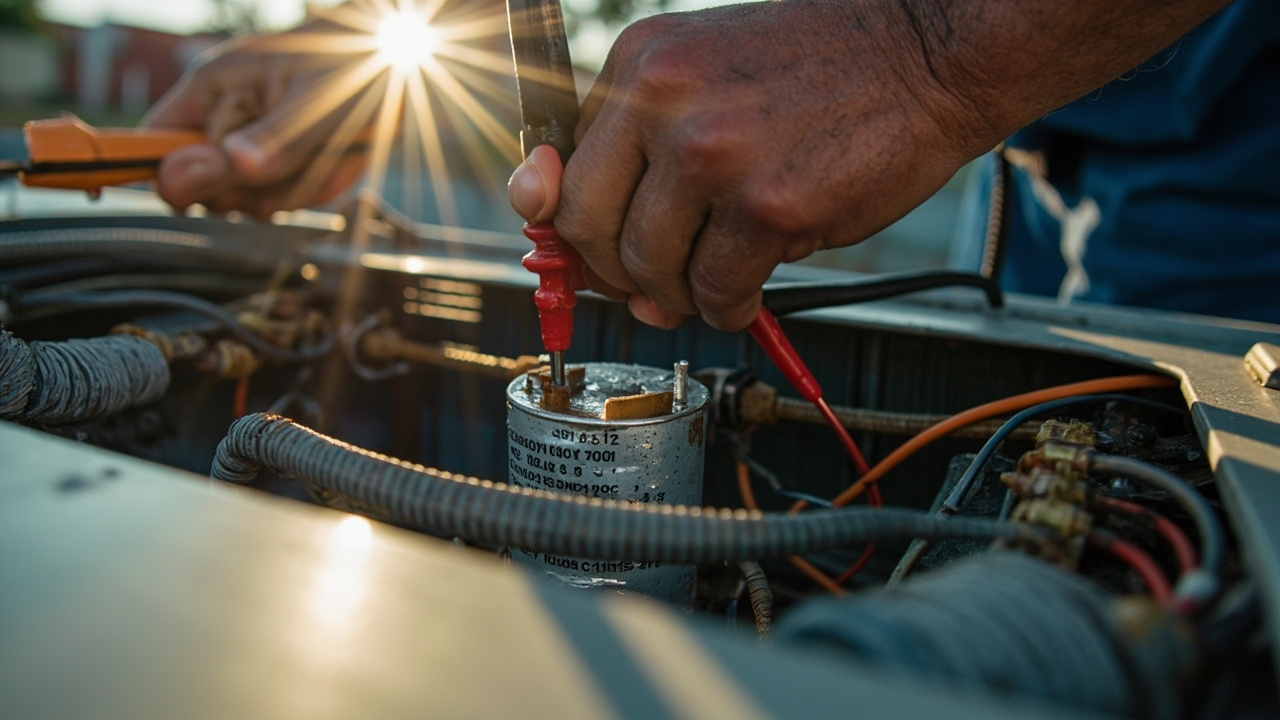
On a commercial no cooling call, the sequence starts outside the sealed refrigerant circuit rather than inside it. Before gauges go on anything, a technician checks the disconnect, the contactor contacts, and the run capacitor, because those parts fail far more often than the compressor they protect and cost far less to replace. Only once the electrical side is confirmed sound does the visit move toward a refrigerant question, and on a packaged rooftop unit that means checking the condenser fan and coil for airflow restriction before charge is ever discussed.
The clamp ammeter is the instrument that decides which branch the fault sits on. Reading amp draw on the compressor and the blower and comparing it against the rated load amps stamped on the unit's data plate shows whether the motor is running within its design range or laboring against something else. A brief spike toward locked rotor amps on start, followed by a shutdown, points at a failing capacitor or a pitted contactor rather than a bad compressor, and replacing the capacitor first is what separates a short repair from an unnecessary compressor condemnation. Steady amps sitting above the rated load once the unit is running, rather than only at start, points the other direction, toward a compressor that is struggling on its own.
Where a building is due for new equipment rather than a repair, the choice usually comes down to a packaged rooftop unit against a light commercial split system. A packaged unit puts the compressor, coil, and blower in one cabinet on the roof, which keeps service access in one place but leaves every component exposed to summer heat and hail at once. A light commercial split keeps the air handler indoors, which is easier to service in winter and shelters the blower motor from weather, while the condensing section stays outside. The two get compared on tonnage per cabinet, on whether an economizer can bring in outside air on mild days to cut compressor runtime, and on how much roof or ground level access a technician has for the service life of the unit.
Your local utility, Utility Bill City of Waco, publishes service and water-quality information every Waco homeowner should know.
Ask which of these readings was taken before any part is replaced.
| Instrument | Good reading | Bad reading | What it changes |
|---|---|---|---|
| Clamp ammeter on the compressor and the blower | Running amps at or below the rated load amps stamped on the data plate | Amps steady above the rating, or a brief spike toward locked rotor on start | A failing capacitor, contactor or compressor |
| Filter, coil and condensate inspection | Light passes through the filter pleats, the coil fins are clean | A matted filter, a coil with ice on it | A homeowner who has never seen the inside of their air handler makes a different decision |
| Two probes for delta T between return and supply air | A 16 to 22 degree drop across the coil in cooling at normal indoor humidity | A small drop means airflow or charge is wrong | An unusually large drop means the coil is being starved of air |
| Manifold gauges with superheat and subcooling readings | Superheat and subcooling both landing in the range the equipment maker specifies for that metering device | High superheat with low subcooling | An undercharge or a restriction rather than a weak compressor |
How an emergency commercial call runs
First call and check
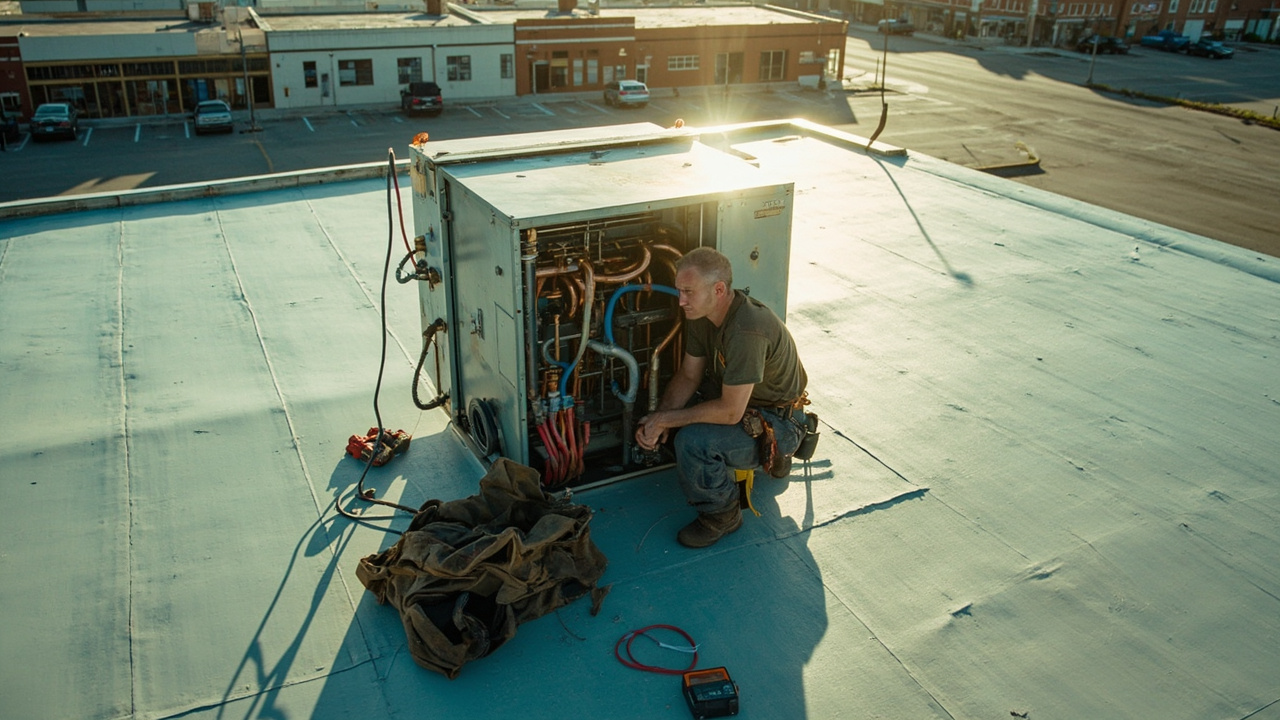
When you call, we ask what the unit is doing, hums and quits, runs without cooling, or one zone warm while others hold, and when that started. We ask whether the space is occupied and what kind of business it serves, since that decides how urgent the visit is. On site, the check starts outside the refrigerant circuit: the disconnect, the contactor, and the run capacitor come first, because those fail more often and cost less than a compressor. Only after that gets confirmed does the visit move to airflow across the condenser coil and then to the clamp ammeter readings on the compressor and blower, compared against the data plate.
Repair with approval
Once you approve the scope based on the amp readings, the disconnect gets locked out first so no one is working on a live circuit. If the fault is a failing run capacitor or a pitted contactor, that part gets replaced and the amp draw gets read again before the disconnect goes back in. If the readings point to compressor or coil damage instead, we stop and walk you through what was found and what replacing that piece involves before any further work happens, since that is a different decision than a part swap.
Verification before leaving
Before the technician leaves, the clamp ammeter goes back on the compressor and the blower, and both need to read at or below the rated load amps on the data plate through a full start and run cycle. We walk you through what was replaced and what the readings showed, and you keep a written note of the amp readings and the part replaced, useful if the same unit needs attention again or if you are deciding whether it is worth repairing next time.
Why a rooftop unit here fails differently than outsiders expect
An outside crew unfamiliar with how Waco summers run these units tends to make one predictable mistake: they open the refrigerant circuit before checking the capacitor and contactor, because a struggling compressor looks the same from the outside whether the fault is electrical or mechanical. That order costs a business hours it does not have, since a rooftop unit down during business hours means lost revenue for every hour the building sits without cooling. A technician who works commercial units in this area routinely checks amp draw first because a hard start pattern is common on units that have run near continuously for months, and skipping that step means condemning a compressor that a capacitor swap would have fixed.
Dispatch logistics change with the season here too. The first stretch of real summer heat and the first hard freeze of winter are the two days when every business with a rooftop unit or a heat pump calls at once, because equipment that idled through mild weather gets asked for full capacity in a single afternoon and fails together. A crew that has not planned for that surge treats each call as an isolated emergency instead of recognizing the pattern, which slows response when demand spikes hardest. Knowing that the surge is coming lets calls get sorted by what the unit is doing rather than by who called first, which matters when one building has no cooling at all and another has one zone running warm.
Commercial rooftop access is its own complication for an unfamiliar crew. Reaching the unit means a ladder or roof hatch rather than a side yard, and carrying a capacitor, a contactor, or a whole condenser section up to the roof takes different equipment than a residential service call ever requires. A crew that shows up without the right ladder, tie-off gear, or lift plan for that access loses time on site, and on a day when a business is losing revenue every hour the unit stays down, that time matters more than it would on a home call.
More detail on commercial hvac contractors is on its own page.
Proper sizing follows the Manual J standard from the Air Conditioning Contractors of America, guesswork is how systems end up short-cycling.
What working with us looks like on a commercial call
Same day rooftop dispatch
When you call about a rooftop unit or a light commercial split system, we ask what the unit is doing, when it started, and whether the space is occupied, because those answers sort a same day dispatch from a scheduled visit. You get a window for when a technician arrives rather than an open ended wait. If a call ahead of yours runs long, especially during the first stretch of summer heat when every rooftop unit in the area is under load at once, we call and give you the new window rather than leaving you checking the roof.
Roof and floor protection
Before a technician goes onto the roof, ladder placement and roof surface get checked so nothing drags across membrane roofing or gravel ballast unnecessarily. Inside, any access point through a ceiling or mechanical closet gets covered before parts come down, and tools stay staged on a drop cloth rather than the sales floor or stockroom. Failed capacitors, contactors, and any refrigerant recovered during the repair leave with the technician rather than sitting in a dumpster on site, and the space gets a walk through before anyone leaves.
What moves the price
Cost on a commercial call moves on a few points: whether the fault is a capacitor or contactor rather than the compressor itself, how hard the unit is to reach on the roof or in a tight mechanical room, and whether calling during the first heat wave or the first hard freeze means dispatch is stacked with every other business calling the same afternoon. The amp readings taken during diagnosis set the scope, and you see that scope, what is being replaced and why, before any repair starts rather than after.
How technicians are checked
A technician working commercial rooftop calls alone has already run a set number of visits alongside a lead, demonstrating tasks like reading amp draw against a data plate and telling a capacitor fault from a failing compressor before being signed off to work solo. On a unit behaving in a way that does not match a familiar pattern, a second technician reviews the readings before a scope gets written, rather than one person guessing under a deadline.
You Have Questions,
We Have Answers
Cost depends on what the readings reveal. A failing run capacitor or contactor costs far less to replace than a compressor, and after hours dispatch during the first heat wave or first hard freeze, when every business calls at once, moves timing and availability more than the repair itself. Diagnosis with amp readings determines the scope of work before you authorize any repairs.
A building with no cooling or no heat, a unit tripping a breaker repeatedly, water coming from an air handler, or a carbon monoxide alarm all count as emergencies. On a carbon monoxide alarm, everyone leaves the building first and the call gets made from outside. A unit that hums and quits or cycles the breaker on every start attempt also qualifies, since that pattern gets worse the longer it runs.
That depends on the lease terms and the specific circumstances, and it is a legal question rather than a mechanical one. What we can tell you is what the unit is doing and whether it is a same day fix or a longer repair, which is often the information a tenant needs to bring to that conversation with a landlord or property manager.
A technician who has run a set number of commercial rooftop visits alongside a lead before working solo, demonstrating ability to interpret electrical parameters against manufacturer specs and distinguish capacitor failure from compressor failure. On a unit behaving in an unfamiliar way, a second technician confirms the diagnostics before a scope is written.
Commercial repair costs move with what is found on the unit rather than a set price, since a capacitor or contactor swap costs far less than compressor or coil work. Access, meaning roof or tight mechanical room reach, and dispatch timing during peak summer or a hard freeze also affect the visit, with no figure fixed in advance.
The amp readings taken on the compressor and blower during the first visit decide the scope, and that scope gets shown to you before any repair starts. A capacitor or contactor swap gets approved differently than a decision to replace a damaged compressor or coil, since one is a part and the other is a system decision.
Some of it, yes. Changing filters, keeping clearance around the outdoor unit, and rinsing accessible condenser fins with the power off at the disconnect are fine for facility staff to handle. It stops at anything behind an electrical panel, the refrigerant circuit, or a gas burner, since those carry real injury risk and need the amp and pressure readings a technician takes to diagnose safely.
That is worth asking when you call, since it can depend on the size and type of the job. What matters for the visit itself is the amp readings and the scope they produce, which get shown to you before any repair work or payment discussion happens.
It depends on which side of the sealed circuit the fault sits on. A capacitor, contactor, or blower motor is a part and usually worth repairing. A compressor that has taken repeated hard starts, or a coil that has failed once already, is closer to a system decision, especially on a unit that is already old and has been patched before.
What Waco summers and McLennan County ground do to a rooftop unit
Waco's humid subtropical climate runs commercial cooling equipment nearly nonstop through a long stretch of summer, with highs in the mid to upper nineties in July and August pushing every rooftop unit to full capacity for months at a stretch. That runtime is what ages a run capacitor faster than the compressor behind it, which is why commercial hvac down calls cluster hard once the heat sets in. Underneath that equipment, McLennan County sits in the Blackland Prairie, where dark clay soil shrinks and swells with rainfall and drought. That movement reaches curbs and outdoor pads over time, tilting a unit that was level when it was installed and putting strain on the line set and its fittings at the point where the refrigerant lines meet the condenser.
The failure pattern shifts with the season rather than staying constant. Cooling season compressor burnout, the kind that follows a run of hard starts on a failing capacitor, peaks in July and August when equipment is under the heaviest load. Hard freezes in the winter months put heat pumps and their defrost cycles under stress instead, and a compressor reversing valve or a set of heat strips can fail the same way a summer compressor does, just from a different cause. The amp and pressure readings taken during either kind of call become a record a facility manager can hold onto, useful for explaining a spike in a utility bill or for deciding whether a repair is worth making against a system already near the end of its service life.
HVAC Services in The Waco Area
Explore our service area and locate Granite HVAC Waco with ease. We're proudly local and serve the surrounding neighborhoods with fast response and honest pricing. Use the map to check our coverage area, or call us and we'll confirm in seconds.
Address:
Granite HVAC Waco, Waco, TX, 76701
Additional Services We Offer
- 24/7 Emergency AC Repair
- After-Hours HVAC Service
- Carbon Monoxide Leak Response
- Emergency Blower Motor Replacement
- Emergency Boiler Repair
- Emergency Compressor Replacement
- Emergency Furnace Repair
- Emergency Heat Pump Repair
- Emergency Refrigerant Leak Repair
- Emergency Thermostat Replacement
- No Cooling Emergency Service
- No Heat Emergency Service
Changing filters, keeping clearance around outdoor condensers, and rinsing accessible fins with power off at the disconnect are jobs facility staff can handle without calling us. Where it stops is refrigerant, anything behind an electrical panel or blower door, and any gas burner or flue, because those carry real injury risk. If a first visit turns up wiring or gas work outside that boundary, we say so on the spot rather than after the fact.
Before you call, know what the unit is doing, whether it hums and quits, runs without cooling, or has one zone warm while others are fine, and when it started. Know the type of space it serves and whether anyone is inside right now. If you know the unit's age or whether it has had recent repairs, have that ready too. Those answers usually tell us whether this needs someone today.
Last reviewed September 2026 by Dale Whitfield, Service manager.