





What water around your indoor unit is telling you
Water around an indoor unit usually shows up in one of two places. Either it is pooling on the floor or the platform under the air handler, or it is a soft stain spreading across a ceiling below the attic where the equipment sits. Both point at the same three parts: the condensate pan under the coil, the drain line running out of the house, and the float switch that is supposed to shut the system down before either one overflows. A musty smell near a supply register often shows up before the stain does, because standing water in a warm pan starts growing something well before it finds its way through drywall.
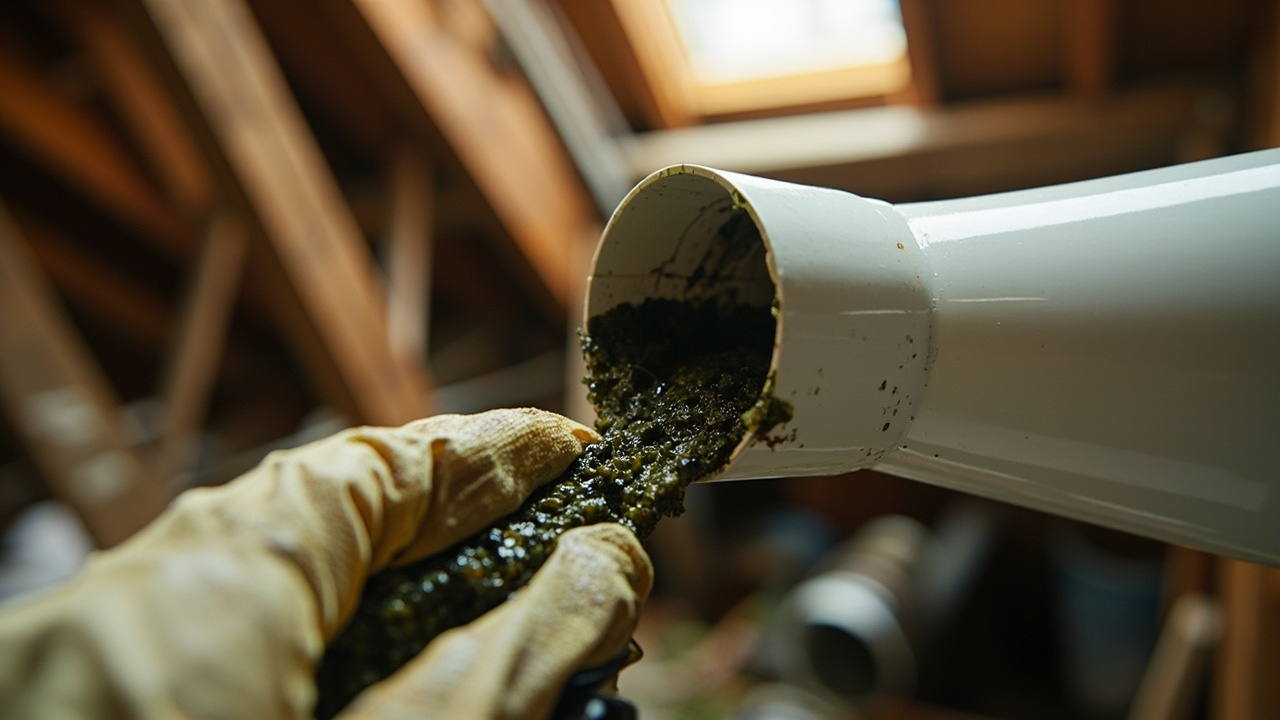
The mechanism behind most of these calls is simple to describe even though the fix is not always quick to reach. Warm, moist air moving across a cold evaporator coil condenses into water that is supposed to drip into the pan and run out through the drain line. When that line narrows or blocks, the pan fills instead of draining, and once it is full the water goes wherever gravity takes it, which in an attic installation is straight down into insulation and drywall.
Waco's late spring and summer humidity is what turns a slow drain into a fast problem. The cooling season here runs long, and the wettest stretch of it lines up with peak condensate volume, so a drain line that carries a trickle of water most of the year is carrying far more through May and June. That extra water sits in the line longer between full system cycles, and a warm, dark, wet line is exactly where algae and biofilm build up fastest, narrowing the passage until it closes.
The sequence from there follows the same pattern on almost every attic system in this area. A plugged condensate drain backs up until the pan overflows into the platform or the ceiling below it. Left alone, the ceiling stains, and once the drywall has been wet long enough, the secondary pan underneath, if there is one, is often rusted through and no longer catches what the primary pan misses. That is the point where a stained ceiling stops being cosmetic and starts being a repeated call, because the same humid stretch that caused it once will cause it again unless the drain itself gets cleared and the pan and switch get checked.
More detail on ac not turning on is on its own page.
Find the sign you have, then read across to see whether it can wait.
| Symptom or first sign | What is already happening | What it becomes if ignored | When to call |
|---|---|---|---|
| A plugged condensate drain | The pan overflows into the platform or the ceiling | The ceiling below stains and the rusted secondary pan lets the rest through | Soon, before it spreads past the repair |
| A slow refrigerant leak | The system runs longer for less cooling and oil stops circulating properly | The compressor loses lubrication and seizes | This week, while it is still one part |
| A weak run capacitor | The compressor pulls high amps every time it tries to start | The windings overheat and what was a part becomes a whole condenser | Now, the same day |

How we trace a condensate leak before touching anything
The order we work in on a leak call starts at the pan, not the coil. Before anything gets opened up, we check whether water is standing in the pan right now, trace the drain line out to where it terminates, and test the float switch by hand to see whether it trips and shuts the system down the way it should. Only after that do we pull the filter and look at the coil, because airflow and condensate are tied together on this kind of call more than most homeowners expect.
Each of those checks rules something out before the next one means anything. A dry pan with a clear drain and light passing evenly through the filter pleats tells us the leak already found somewhere to escape, which changes where we look next. Standing water with a coated or rusted float switch that never tripped tells us the safety device failed along with the drain. A matted filter or an iced coil changes the diagnosis entirely, because restricted airflow drops the coil below freezing, and the melt from that ice is often what overflows a pan that would otherwise have handled normal condensate fine.
Filter choice gets checked against this problem rather than judged on its own. A high MERV filter dropped into a slot built for a thinner one inch pleated filter adds resistance to the airflow crossing the coil, and on a system already running long hours through a humid stretch, that added resistance can be enough to push the coil toward icing. A deeper media cabinet carries the same filtration rating with more surface area and less pressure drop, so where filtration and condensate problems show up together, the fix sometimes has less to do with the drain line and more to do with what is sitting in front of the coil. That is why we photograph the filter and the coil condition on every call, so the equipment configuration stays part of the record when the next service visit happens.
If this sounds close but not quite your situation, ac blowing warm air may be the better starting point.
Permit and inspection questions? Commercial Construction Permits is the office we coordinate with on every permitted Waco job.
Ask which of these readings was taken before any part is replaced.
| Instrument | Good reading | Bad reading | What it changes |
|---|---|---|---|
| Filter, coil and condensate inspection | Light passes through the filter pleats, the coil fins are clean | A matted filter, a coil with ice on it | A homeowner who has never seen the inside of their air handler makes a different decision |
| Manometer for total external static pressure across the air handler | Static pressure at or under the maximum printed on the blower data plate | Static above the rating | The filter, the coil or the duct is choking the system |
| Flame sensor signal check in microamps | A steady signal well above the control board dropout point | A weak or drifting signal | The sensor is coated and the burner will drop out |
| Clamp ammeter on the compressor and the blower | Running amps at or below the rated load amps stamped on the data plate | Amps steady above the rating, or a brief spike toward locked rotor on start | A failing capacitor, contactor or compressor |
How a condensate leak call runs
First call and inspection
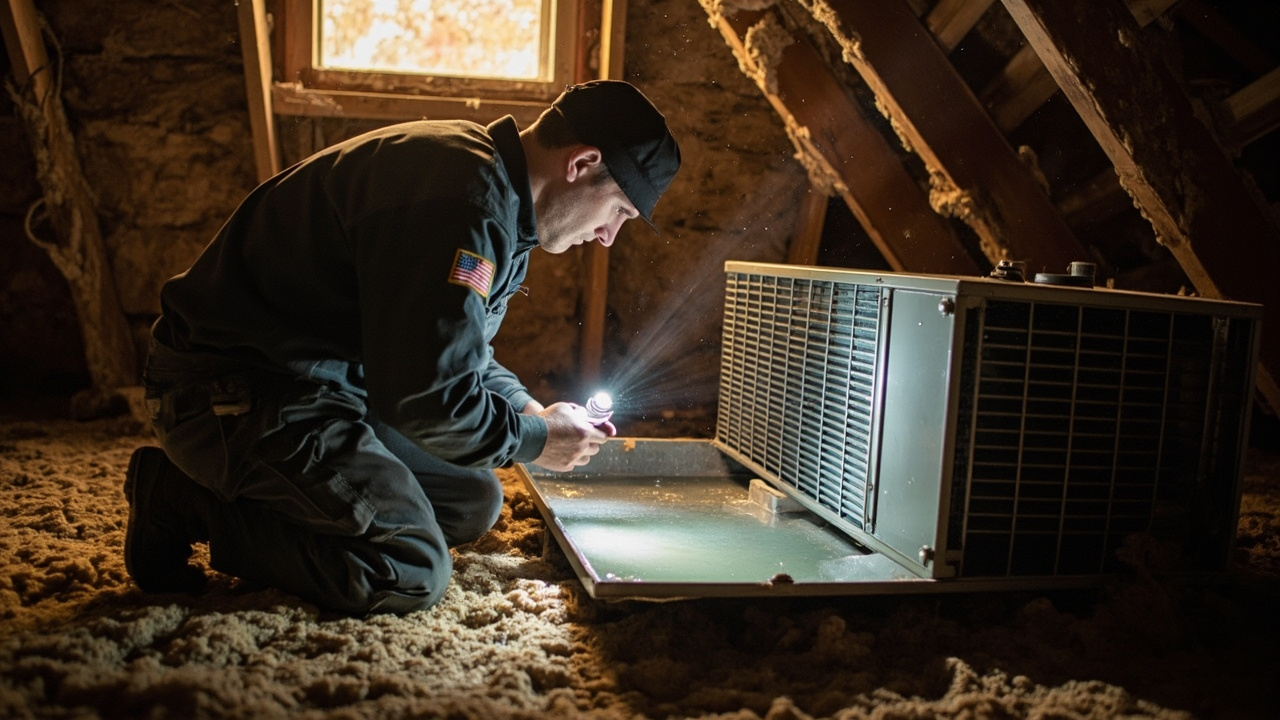
On the phone we determine where moisture appears, when it started, and whether the system is still running, since those answers decide how urgent the visit is. On site, we start at the pan and the drain line rather than the ceiling stain, because the stain only tells us damage already happened. We trace the line to its termination point, test the float switch by hand, then pull the filter and check the coil for ice or buildup. That order tells us whether the fault is a clogged line, a failed switch, or airflow starving the coil, before we say anything about what it will take to fix.
Repair and approval
Once you approve the written scope, the system gets shut off at the thermostat so no new condensate adds to standing water while the line is being worked on. Clearing the drain comes first, followed by cleaning or replacing the float switch if it failed to trip, and flushing the pan itself. If the filter or coil condition points at airflow as part of the problem, we show you what we found, coil ice, a matted filter, before changing anything there. Nothing beyond the approved scope gets touched without stopping to show you first.
Confirming it drains
Before we leave, the system runs long enough to generate condensate under normal operation, and we watch the pan stay dry while the drain line carries water out to its termination point without backing up. The float switch gets tested again once the line is clear, confirming it will trip if the pan ever fills again. We walk you through what was cleared or replaced and point out the drain access for next time, and you keep a note of what was found and fixed for your own records.
Why this fails differently in an attic here than it does elsewhere
A lot of Waco housing built from the 1970s onward put the air handler and its ductwork in the attic, above a finished ceiling, with a single condensate line running to the outside. That layout means a slow clog does not show up as a puddle on a slab, it shows up as a stain on a ceiling, and by the time the stain is visible the drywall and insulation above it have usually been wet for a while. Crews unfamiliar with that layout sometimes treat the stain as the whole job and patch the ceiling without ever confirming the drain and pan were fixed first, which means the same stain comes back the next humid stretch.
The other mistake is chasing refrigerant charge on a leak call. Low refrigerant can make a coil sweat more than it should on the outside of the cabinet, but it does not clog a drain and it does not crack a pan, so adding refrigerant to a unit with a blocked line changes nothing about the actual leak. The pan, the switch and the line each require separate verification as their own distinct step in the diagnostic sequence. Bundling condensate work into a refrigerant top off because that is the faster looking fix misses the actual source of the problem.
Attic access itself changes how the job goes. Older attic platforms in this area were not built with much room around the air handler, so a line that clogs deep in the run, past where it is easy to reach from the access hatch, takes more time to trace and clear than a line that clogs right at the unit. The path the condensate takes from the evaporator coil to the exit, the depth of the clog in that path and the accessibility of each section all affect how the blockage gets cleared. Knowing those variables going in is what keeps the visit from turning into guesswork once the hatch is open.
See ac constantly running for how the related work is scoped and priced.
What the leak repair visit looks like
Getting someone to your door
When you call, we ask where the water is showing up, how long it has been happening, and whether the system is still running. Those answers tell us whether the pan is actively overflowing or the leak has slowed on its own, which decides same day scheduling against a booked visit in the next couple of days. You get a window before the technician heads out, and if a job ahead of yours runs long inside an attic, we call to move your time rather than leave you waiting.
Keeping the attic access clean
Before the attic hatch opens, drop cloths go down on the floor below it and along the path to the air handler, since attic dust and old insulation come down with anyone climbing up. Tools and parts stay staged on a tarp rather than the platform itself. Any water already pooled in the pan gets removed into a container before the drain is cleared and disposed of properly rather than spilling onto the ceiling below. Once the line runs clear and the pan is dry, the area gets wiped down and the drop cloths come up last.
What decides the price
Access is usually the biggest factor on a leak call. A drain clog reached easily through an attic hatch clears fast. A pan or switch buried behind ductwork in a tight attic platform, with no easy path to it, takes longer to reach and adds labor before the repair itself even starts. We write down what we found, what it will take to fix, and what drove the price into that scope before anything gets touched, and you see that written scope and say yes to it before work begins.
How a technician earns the call
New technicians work alongside a lead on attic and platform jobs before they trace a drain line or test a float switch on their own, since a missed clog or a switch left untested is what sends a homeowner back to a stained ceiling. The lead signs off once a technician can trace a line to its termination point and confirm a dry pan under a running system. On anything unusual, standing water with no clear source or a switch that will not hold a test, a second technician looks at it before a scope gets written.
You Have Questions,
We Have Answers
Cost depends mostly on access and on which of the three points failed. A drain line clog reached easily through an attic hatch is the simplest repair, while a pan or switch concealed beneath heating ducts in cramped quarters takes longer to reach and costs more in labor. We name what drove your price on the visit before any work starts.
Running it keeps adding water to a pan that is already overflowing. Shutting the system off at the thermostat stops new condensate from forming while you wait for someone to look at the drain, the pan and the switch, and it keeps a small ceiling stain from becoming a soaked section of drywall.
Water appearing after the system shuts off is usually water that was already sitting in a clogged drain line or an overfilled pan working its way out slowly. Backed up water finally finding a path, rather than new condensate being produced, still points at the same drain and pan check.
Stopping it means clearing whatever is holding water back, the drain line, the pan or a failed float switch, rather than just wiping up the drip. Granite HVAC Waco traces the line and tests the pan and switch by hand on the same visit, and checks whether the original sizing is even keeping up with the load before calling it done. Call (254) 221-8461 to get that traced instead of guessed at.
Why Waco humidity fills condensate pans fast
Cooling season here runs from spring into October, and the most humid stretch lands in late spring and early summer, which is exactly when condensate volume peaks. A lot of the housing stock in this area, from ranch homes built with attic ductwork on through more recent construction, keeps the air handler and its drain line in the attic rather than a closet or basement, so that extra summer water has to travel further before it leaves the house. Expansive clay soils under the region also shift outdoor pads and foundations over time, and that same movement can tip an indoor platform slightly out of level, which changes how well a pan drains even when the line itself is clear. These conditions combine to make condensate backup more likely during peak cooling months.
The City of Waco supplies treated surface water from Lake Waco that runs moderately hard, carrying calcium and magnesium that leave mineral scale behind in anything that handles standing water over time, condensate lines included. That scale narrows a line already fighting algae growth through the humid months, so a drain that seemed fine the year before can clog faster once both are working against it. Local practice on a lot of these systems is to run the condensate line to grade outside or tie it into a trapped plumbing connection, and either way the discharge point needs to stay clear of the foundation, since added water next to a slab on this region's clay soil makes existing movement worse rather than better. Knowing which discharge method a house was built with changes where we look first when a line backs up, because a line tied into plumbing fails differently than one that simply drains to the yard.
HVAC Services in The Waco Area
Explore our service area and locate Granite HVAC Waco with ease. We're proudly local and serve the surrounding neighborhoods with fast response and honest pricing. Use the map to check our coverage area, or call us and we'll confirm in seconds.
Address:
Granite HVAC Waco, Waco, TX, 76701
Patching a stained ceiling is a homeowner or a painting contractor job once the leak itself is fixed, and that is not something we do. Where our work stops is at the drain, the pan, the switch and the coil, because those are the parts that decide whether the ceiling stains again. If what we find points at structural water damage in the framing, we say so on the first visit and tell you it needs a different trade before that part goes back together.
Before you call, know exactly where the water is showing up, whether it is under the unit, on a ceiling or on the wall, and when you first noticed it. Note whether the system has been running nonstop through a humid stretch and whether anyone has poured anything down the drain line before. If you know roughly how old the unit is, mention it, since that helps us judge whether sizing is part of the problem.
Last reviewed September 2026 by Dale Whitfield, Service manager.