




What rising run time on a rooftop unit signals before it fails
A property manager usually describes it the same way. The rooftop unit is running longer every week, the tenant space still reads a few degrees above setpoint by mid afternoon, and the utility bill for that meter has climbed without anyone changing the thermostat schedule. On a packaged unit, that pattern rarely means the compressor is dying outright. It means the amount of heat the unit removes per hour has slipped, and the building is compensating with runtime the equipment was never sized to carry indefinitely. That distinction matters for how the problem gets budgeted, not just how it gets repaired.
The mechanism behind that drift is almost always airflow or charge, and the two leave different fingerprints. A coil starved by a loaded filter, a dirty return, or condenser fins flattened by hail runs colder at the coil face and delivers warmer air at the register, with energy draw climbing while cooling output falls. A slow refrigerant leak reads differently. The unit still satisfies the space eventually, just later than it used to, while the compressor cycles on a charge that gets a little lighter every week it goes unaddressed. Neither produces a hard outage on day one, which is why a comfort complaint or an energy line item is usually the first documented evidence, not an alarm or a tripped breaker.
Left alone, a slow leak follows a fixed sequence. The system runs longer for less cooling as charge drops, and the oil that should circulate with the refrigerant through the compressor stops moving the way the compressor was built to depend on. Once that lubrication path fails, the compressor seizes, and a job that started as a leak search and a recharge turns into a full unit replacement, charged to whichever budget cycle the seizure happens to land in.
Not every complaint is a breakdown, though, and treating one as the other wastes a service call. A single zone that never matches the rest of the floor plan, or a building that reads comfortable on the thermostat but still feels heavy with moisture at the register, is rarely a sealed circuit problem at all. That pattern points at duct sizing, a return path starved by a tenant buildout, or a unit staged for temperature rather than moisture removal, and no capacitor, contactor, or compressor swap changes any of it. Knowing which category a complaint falls into before scheduling a repair is what keeps one service ticket from becoming two for the same underlying condition.
See building automation & controls for how the related work is scoped and priced.

How we sequence a rooftop unit call before quoting anything
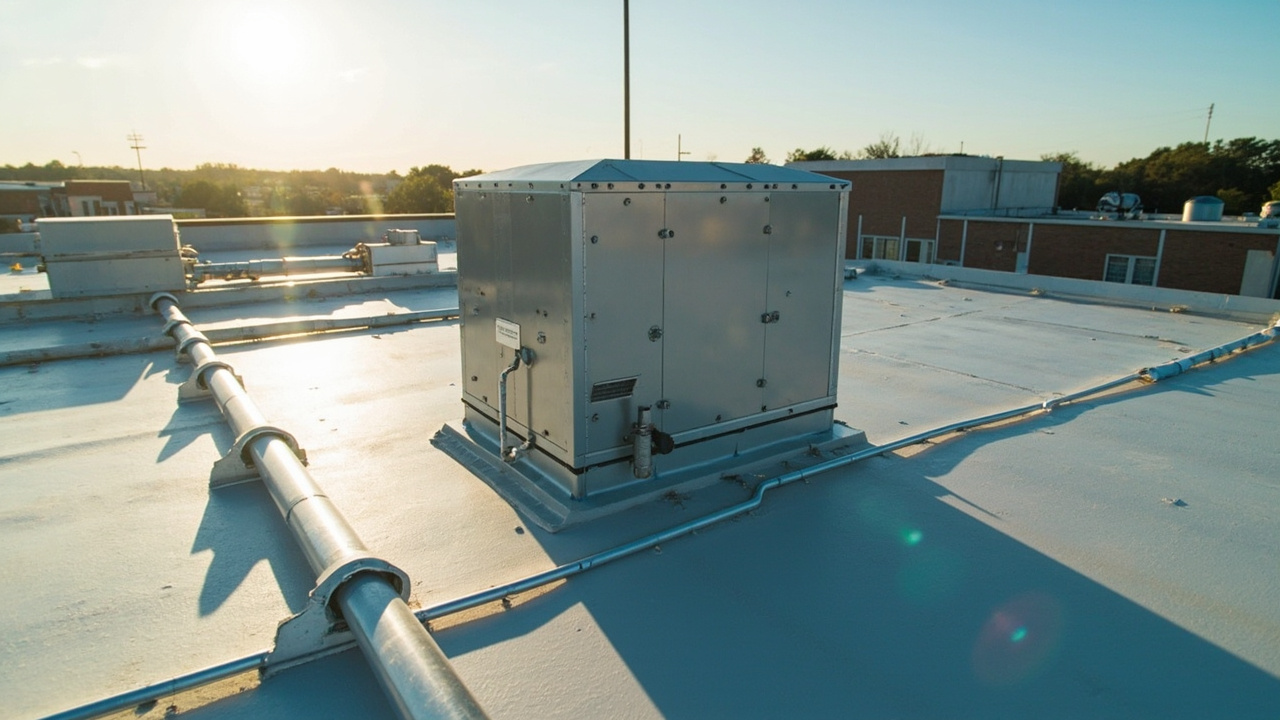
The visit starts on the ground, not the roof. We pull the unit's data plate specs, run the disconnect check, and confirm what the last service record shows before climbing the ladder, because a unit that has been topped off before without the leak found is a different job than one seeing a technician for the first time. On the roof, the sequence goes filter and coil condition first, then airflow, then electrical, then the refrigerant circuit last, in that order, because charging a unit before airflow is confirmed is a guess dressed up as a repair.
The clamp ammeter goes on the compressor and the blower motor early in that sequence. A reading at or under the rated load amps stamped on the data plate means the motor windings and the load they are pulling are healthy, and the fault sits somewhere else. A reading holding above rated amps, or spiking toward locked rotor on start, points at a failing capacitor or a pitted contactor long before it points at a dying compressor, and checking the capacitor first saves a property manager from paying for a compressor that was never the problem. That single reading decides whether the visit ends with a part swap or continues into the sealed circuit.
Packaged rooftop units and light commercial split systems get compared on tonnage per cabinet and on service access, and the comparison matters more in a replacement decision than the efficiency sticker does. A rooftop unit puts the compressor, coil, and blower in one weatherproof cabinet on a roof curb, which simplifies the building's mechanical footprint and can include an economizer for free cooling when outdoor air is mild enough. A light commercial split system puts the air handler indoors, which means winter service happens without anyone on the roof, at the cost of a cabinet split across two locations and a line set that has to be run and protected. Which one makes sense depends on the existing curb, the roof's condition, and whether indoor mechanical space already exists.
The difference in installation complexity also extends to ductwork and thermostat placement. A rooftop unit typically feeds a single ductwork trunk, while a split system requires careful routing of refrigerant lines and often demands modifications to existing ceiling cavities or wall penetrations. Both configurations demand different maintenance schedules and access protocols once they are operating.
More detail on chiller repair & maintenance is on its own page.
How a rooftop unit visit runs
First call and rooftop assessment
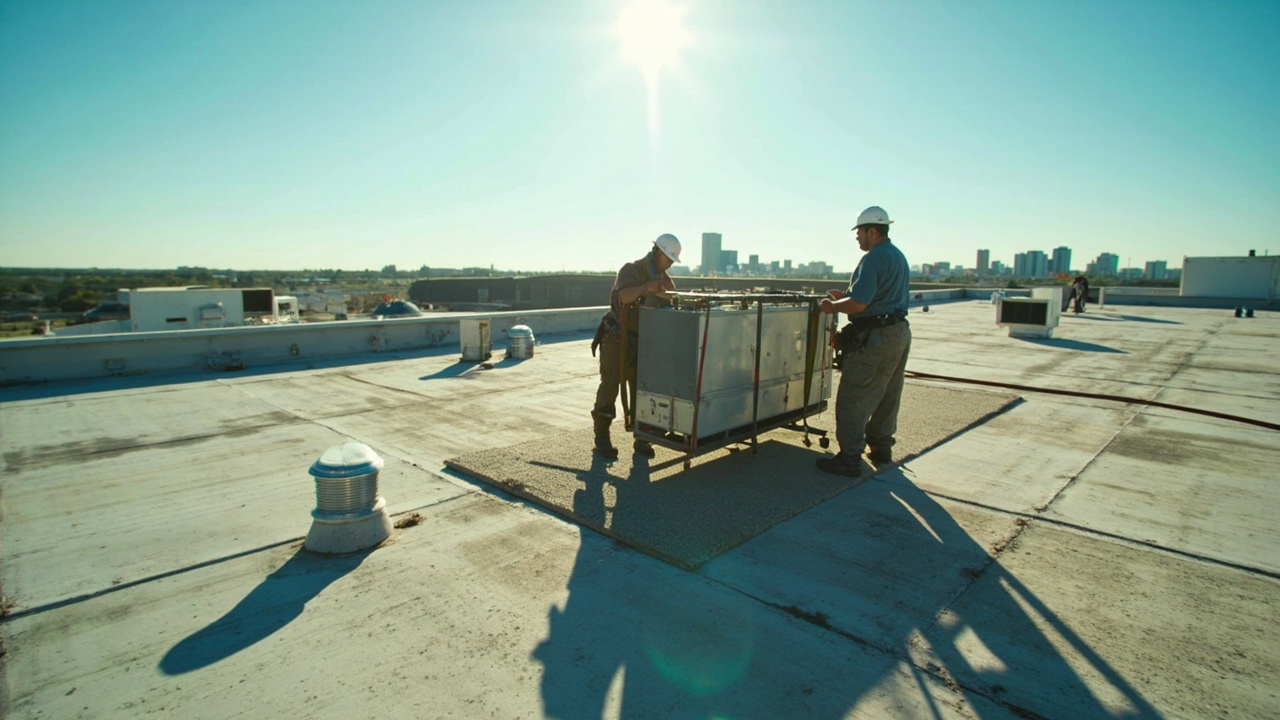
On the phone we ask what the unit is doing, whether it runs on gas or electric heat, and what the roof access looks like, since that decides whether a ladder, hoist, or crane has to be staged before anyone climbs. On site, the sequence starts at the data plate and the filter and coil condition, then moves to airflow across the coil, before any electrical or refrigerant testing begins. Checking airflow first means a technician is not chasing a refrigerant reading that a restricted coil would have explained on its own. That order holds on every visit regardless of what the complaint sounded like on the phone.
Approved repair sequence
Once the scope is approved, the disconnect gets opened before anything inside the unit cabinet is touched. From there the capacitor and contactor get checked against the clamp ammeter reading taken earlier, since a weak capacitor is a cheaper fix than a compressor and gets ruled out first. If the refrigerant circuit needs work, the filter drier gets changed and the system gets evacuated properly rather than topped off over a leak that was never found. If hail damage to the coil fins or a bent curb turns up mid repair, work stops and that finding gets shown before the scope grows any further.
Verification and handover
Before anyone leaves the roof, the clamp ammeter goes back on the compressor and blower motor, and the reading must fall within manufacturer specifications stamped on the data plate before the visit is called finished. We walk the property contact through what was found, what was replaced, and what the readings were, and that record goes into the building's service file rather than staying on a single ticket. For a property managing more than one rooftop unit, that documented baseline is what the next technician checks against the following season instead of starting over.
Why rooftop equipment gets engineered instead of swapped
Waco sits in a part of Texas where severe wind on a roof is not a hypothetical. The 1953 Waco tornado tore through downtown and the south side, and it is still the storm event people here measure against when they talk about what a roof structure, and anything bolted to it, has to survive. A rooftop package unit is the largest single object exposed to that kind of wind loading on most commercial buildings, and the connection between the unit, its curb, and the roof deck underneath decides whether it stays anchored through a straight line wind event or a rotating one.
A crew that does not work this market regularly tends to treat a curb swap as a bolt pattern match and stop there. What gets missed is the condition of the existing curb gasket and anchor points after years of sun and hail cycling the roof membrane around them, and whether the replacement unit's weight distribution lines up with the same structural members the old one bore down on. Setting a heavier or differently balanced unit on a curb without checking that distribution can leave a section of roof carrying more load than it was framed for, a problem that shows up later as decking flex rather than anything visible at handover.
The structural members supporting the curb take load at specific points determined by the original equipment manufacturer's specifications. A new unit with a different footprint or weight concentration can transfer that load to areas the framing was never calculated to handle. This becomes especially critical when the existing deck already shows signs of previous deflection or when the roof was built to minimum code requirements rather than a higher safety margin. Confirming that structural match before the crane sets the unit down takes longer than a straight swap, and it is the difference between a unit still anchored after the next severe wind event and one that becomes the point of failure when that 1953 benchmark storm arrives.
If this sounds close but not quite your situation, make-up air unit service may be the better starting point.
Permit and inspection questions? Commercial Construction Permits is the office we coordinate with on every permitted Waco job.
Use this to ask what is driving the quote rather than asking for a rough number.
| Driver | Why it moves the estimate | What you control |
|---|---|---|
| Access and rigging | An attic, a crawlspace, a tight closet or a rooftop with no easy path | Clearing the work area and the path before the crew arrives |
| Controls | The thermostat, zoning and any communicating equipment | How much control you want built into the system |
| After hours dispatch during the first heat wave | Everyone calls at once | Calling in working hours when the problem can wait |
| The capacity and efficiency tier of the equipment chosen | Whether the indoor coil is matched to the new outdoor unit | The grade you choose, the rest of the work is set by the house |
What working with us on a rooftop unit looks like
Scheduling around your roof access
A call starts with three questions, what the unit is doing, whether it is a gas or electric package unit, and whether the building has roof access or needs a ladder or hoist arranged. That tells us whether it is a same day dispatch or a scheduled visit with rigging planned in advance. You get a confirmed arrival window before anyone climbs. If a job ahead of yours runs long because of unexpected rigging, we call and reset the window rather than leave you guessing.
Protecting your building and tenants
Roof access points and interior ceiling tiles near the mechanical room get covered before anything is disconnected, since refrigerant and condensate lines run through both. Any debris from an old curb, coil, or filter comes down bagged rather than staged loose on the roof edge. If tenant spaces are occupied during the work, we coordinate noise and access timing with your on-site contact rather than showing up unannounced during business hours.
What sets the cost
Access and rigging move this job further than tonnage does. A curb that matches the old footprint and a roof with a clear crane or hoist path keeps the job to a straightforward swap, while a mismatched curb, a tight roof edge, or a unit that has to be hand carried across the roof adds hours before any refrigerant work starts. Electrical service capacity and structural load distribution follow behind that. A written scope goes to you with each of those addressed before any work begins, and nothing proceeds without your signoff on it.
How we check a technician's work
A technician working rooftop equipment has already run commissioning checks alongside a lead on live jobs, and the lead signs off specifically on reading a clamp ammeter correctly and pulling a proper vacuum before a unit gets left unattended. On anything involving an unfamiliar curb configuration or a gas-fired unit's combustion path, a second technician reviews the readings before the scope gets written.
You Have Questions,
We Have Answers
Cost depends on tonnage, curb match, and roof access rather than a fixed number. A unit that fits the existing curb and has a clear crane or hoist path stays closer to replacement, while misalignment with the curb footprint, tight roof edge, or an electrical service upgrade adds hours before refrigerant work even starts. Gas-fired units add flue and combustion air work that electric units skip. A written scope covering each factor comes to you before anything is approved.
Rooftop units sit fully exposed to sun, hail, and wind, which wears capacitors, contactors, and coil fins faster than equipment kept indoors. Service access is harder, since a technician has to get a ladder, hoist, or crane to the roof rather than walking into an equipment closet, especially in a winter storm. Everything, compressor, coil, and blower, sits in one cabinet, so a single failure point can take down heating and cooling together instead of leaving one system running while the other is repaired.
Why exposed rooftop equipment needs local engineering and code review
Waco's long cooling season pushes a rooftop unit through months of near-continuous run time in direct sun, which ages capacitors, contactors, and fan motors faster than the same components would wear indoors. The humid stretch of late spring and early summer raises the latent load a rooftop unit has to remove on top of temperature, which is why a unit that satisfies the thermostat can still leave a building feeling damp if it was sized on tonnage alone. Hail storms common to the area flatten condenser coil fins across the unit's exposed face, cutting airflow across the outdoor coil and showing up later as a unit that runs longer for the same result. None of that shows from the ground, which is the case for a rooftop inspection before a season change rather than after a failure.
Electrical service capacity gets checked against Oncor's delivery to the building before a new unit goes on the curb, since a larger or more efficient replacement unit can pull a different load than the one it replaces. Where a rooftop unit runs on gas heat, the connection ties into Atmos Energy's service to the building and gets sized to the unit's input rating rather than assumed from the old equipment. Properties with multiple rooftop units across a portfolio benefit from keeping amp readings, charge verification, and thermal balance numbers from each visit on file, so the next technician on that roof starts from a known baseline instead of guessing at what changed since the last service. This practice prevents oversizing that would waste energy and undersizing that could trigger nuisance shutdowns.
HVAC Services in The Waco Area
Explore our service area and locate Granite HVAC Waco with ease. We're proudly local and serve the surrounding neighborhoods with fast response and honest pricing. Use the map to check our coverage area, or call us and we'll confirm in seconds.
Address:
Granite HVAC Waco, Waco, TX, 76701
Additional Services We Offer
- Building Automation & Controls
- Chiller Repair & Maintenance
- Commercial AC Repair
- Commercial Boiler Services
- Commercial Ductwork Fabrication & Installation
- Commercial HVAC Contractors
- Commercial HVAC Preventive Maintenance Contracts
- Commercial Refrigeration Services
- Make-Up Air Unit Service
- Restaurant Kitchen Ventilation & Exhaust
- Retail & Office HVAC Systems
- Server Room & Data Center Cooling
Roofing repair, curb flashing, and structural roof deck work go to a roofer or structural contractor before we set or reset a unit. A property manager can keep roof access clear and report when a unit visibly iced, tripped a breaker, or ran longer cycles. If a first visit finds roof deck damage or wiring beyond the disconnect, we tell you that visit and name who handles it.
Before you call, know what the unit is doing, running long, tripping, or blowing warm, and when it started. Have the unit's age or model if it is on file, the fuel type, and whether roof access needs a ladder or a lift arranged. If tenants are affected, know which spaces. Those answers determine response time.
Last reviewed September 2026 by Dale Whitfield, Service manager.