





What a dead AC at night in Waco usually means
Most calls start the same way. It runs and runs and the house never cools, or the unit outside hums for a second and then goes quiet, or the breaker trips and the air handler falls silent altogether. Each of those is a different failure, and none of them means the compressor is dead, no matter how it sounds from the kitchen at midnight.
A hum followed by a trip almost always starts with the compressor trying to start under a full load and not getting the jolt it needs. That points at a run capacitor that has been asked to fire the compressor thousands of times through a summer of near constant cycling, not at the compressor itself. A unit that runs but blows warm is a different mechanism entirely, usually airflow or charge, and gets sorted before anyone touches the outdoor unit's electrical components. Sorting which failure you have matters more at night than in daylight, because a wrong guess in the dark means a technician arrives for the wrong problem.
The escalation that matters here follows one path. A weak run capacitor makes the compressor pull high amps on every start attempt. Those high amps heat the windings a little more each time the thermostat calls for cooling. Left alone through repeated cycles, what would have been a capacitor swapped in minutes becomes a compressor that has to be replaced along with the rest of the outdoor unit. That is the point where waiting costs a part rather than a bag of parts, and it is why a hum and trip pattern repeating more than once in the same night is the signal to call rather than to keep resetting the breaker and hoping the next start holds.
The breakdown pattern tells you when to wait and when to act. A house running warm with no hum or trip can often wait for a same day air conditioning repair service visit. A unit that hums, trips, and is asked to start again and again through the night is the one that turns into a bigger repair by morning. The difference between the two is whether the compressor windings are taking heat damage with each failed start or sitting idle and cool. Once high amp draw enters the picture on repeated attempts, the compressor is moving closer to failure with each cycle, which is why the pattern matters more than any single event.
See emergency commercial hvac repair for how the related work is scoped and priced.
How we read the compressor before replacing parts
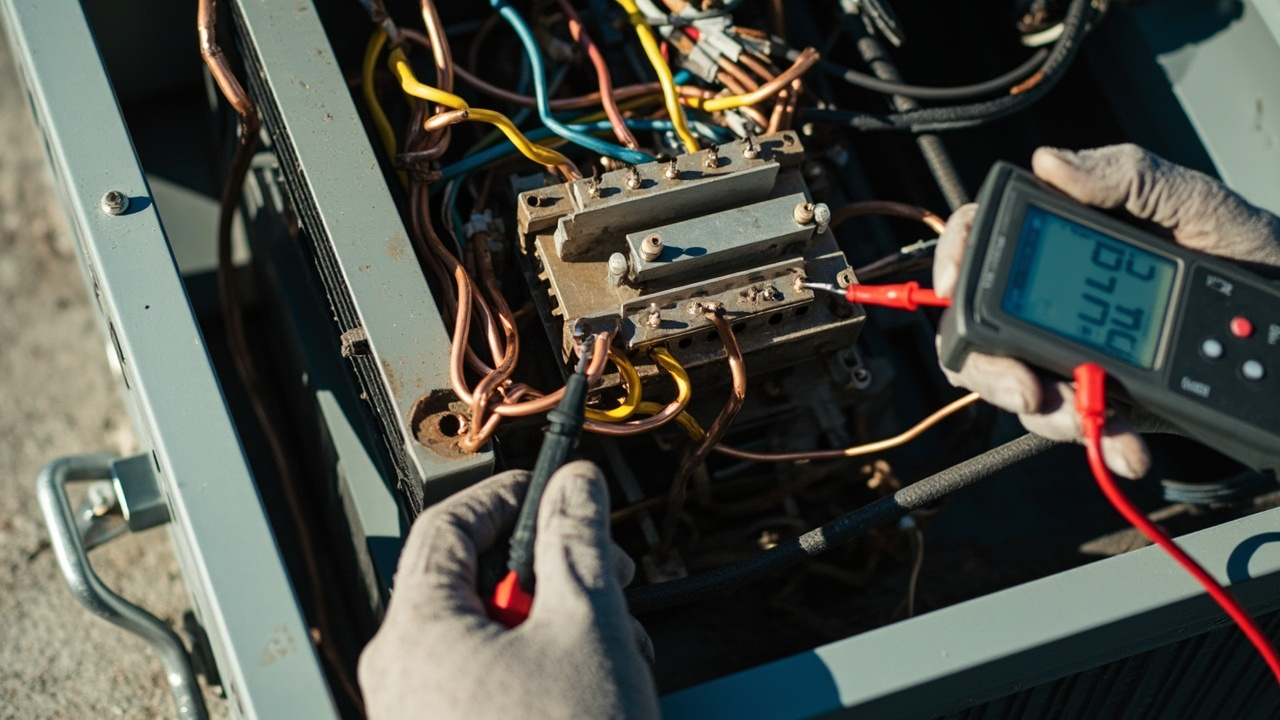
On a call like this the sequence starts before the gauges or the meter come out. We check the thermostat call for cooling, the outdoor disconnect, and the breaker itself, because a breaker that has already tripped once tells us not to reset it a second time. We look fast at the filter and the visible return path, since restricted airflow can trip the same overload protection an electrical fault trips. Only once airflow is cleared does the diagnosis narrow down to the outdoor unit and its start components.
The reading the rest of the visit turns on is a clamp ammeter placed on the compressor and the blower while the system is asked to start. Running amps sitting at or below the rated load amps stamped on the data plate means the windings are fine and the fault sits upstream, most often in a dual run capacitor or a pitted contactor. Amps holding above that rating, or a spike toward locked rotor on start, point at a compressor that is already struggling, and that single reading decides whether tonight ends with a capacitor in a bag or a longer conversation about the compressor. The table alongside this section carries the rest of the readings taken on the same visit and what each one rules in or out.
Where the compressor itself checks out sound, staging still matters for what happens after the repair. A single stage condenser restarts at full capacity every time the thermostat calls for cooling, which is exactly the load event that stresses a marginal capacitor, while a two stage or variable capacity unit ramps into the load and runs longer at a lower draw. That difference does not change tonight's repair, but it changes the interval between service calls once the current heat wave passes and demand settles back to normal levels. Understanding this staging behavior helps explain why some systems need attention again within weeks while others run problem-free through the next cooling season without further issues.
Our page on emergency blower motor replacement covers that side of the work in more depth.
Your local utility, Utility Bill City of Waco, publishes service and water-quality information every Waco homeowner should know.
Ask which of these readings was taken before any part is replaced.
| Instrument | Good reading | Bad reading | What it changes |
|---|---|---|---|
| Clamp ammeter on the compressor and the blower | Running amps at or below the rated load amps stamped on the data plate | Amps steady above the rating, or a brief spike toward locked rotor on start | A failing capacitor, contactor or compressor |
| Two probes for delta T between return and supply air | A 16 to 22 degree drop across the coil in cooling at normal indoor humidity | A small drop means airflow or charge is wrong | An unusually large drop means the coil is being starved of air |
| Flame sensor signal check in microamps | A steady signal well above the control board dropout point | A weak or drifting signal | The sensor is coated and the burner will drop out |
| Micron gauge during evacuation | Below 500 microns and holding there after the pump is valved off | A reading that climbs back up | Moisture is still boiling off inside or the system is not sealed |
| Manometer for total external static pressure across the air handler | Static pressure at or under the maximum printed on the blower data plate | Static above the rating | The filter, the coil or the duct is choking the system |
| Manifold gauges with superheat and subcooling readings | Superheat and subcooling both landing in the range the equipment maker specifies for that metering device | High superheat with low subcooling | An undercharge or a restriction rather than a weak compressor |
| Filter, coil and condensate inspection | Light passes through the filter pleats, the coil fins are clean | A matted filter, a coil with ice on it | A homeowner who has never seen the inside of their air handler makes a different decision |
How an emergency call runs

First call and arrival
When you call, we ask what the unit is doing right now, whether the breaker has tripped more than once, and whether anyone in the house is vulnerable to the heat. That tells us whether this is tonight's call or one that can hold until morning. On site, the technician verifies the thermostat is commanding the compressor, checks the outdoor disconnect and main breaker, then inspects the filter condition and return air passages, since blockages can activate the same protection device that electrical problems do. Once airflow flows freely does troubleshooting proceed to the outdoor unit.
Finding the fault
With power locked at the disconnect, the technician pulls the access panel and inspects the run capacitor and contactor before touching anything electrical. The clamp ammeter measures current draw at the compressor and blower during startup, and that reading determines whether this is a capacitor and contactor repair or something further into the compressor itself. If the amps come back ambiguous, we stop and show you the reading before deciding anything, rather than replacing a part on a guess.
Confirming it holds
After the repair, the ammeter goes back on the compressor and the blower to verify the system draws within specification before the visit ends. We run the system through a full cooling cycle rather than a quick test, since a marginal repair often shows up on the second start rather than the first. You keep the reading we took and what it means for the part that was replaced.
Why local experience changes an emergency AC call
A crew that does not work this ground every summer tends to treat a hum and trip complaint as a compressor call before checking anything upstream of it. That assumption costs a homeowner a compressor that never needed replacing, because the same symptom shows up when a capacitor has weakened after weeks of continuous afternoon cycling. Reading amp draw before opening a parts box is the difference between a short repair and an unnecessary system decision, and it only happens when the technician expects the capacitor to be the more likely fault rather than the exception.
The other thing an outside crew misses is what a heat wave does to dispatch itself. When outdoor temperatures hold in the mid to upper nineties for days in a row, outdoor units across the county are cycling nearly nonstop at the same time, and that is exactly when weak capacitors and pitted contactors give out together rather than one at a time. A technician who has worked through that kind of week before expects the volume and plans a route accordingly, rather than being caught off guard by how many calls come in on the same humid night. That familiarity is what keeps a same night visit closer to an hour than to several hours of waiting.
Ground movement adds a slower version of the same problem. Expansive clay soils here shrink in the dry months and swell again once rain returns, and that movement tilts outdoor pads and stresses the line set and the electrical connections at the disconnect over time. A crew unfamiliar with how often that happens locally may not think to check whether the unit has shifted out of level before condemning a part that failed simply because it was working at an angle it was never installed at. Checking pad level takes a minute and changes what gets blamed for the failure. The technician who knows this ground recognizes that symptom immediately and avoids recommending work that would not solve the underlying issue.
If this sounds close but not quite your situation, emergency boiler repair may be the better starting point.
What it is like working with us after hours
Same night dispatch
You call and describe what the unit is doing, whether it hums and trips, runs and blows warm, or has gone silent completely. That description tells the dispatcher whether this is a same day ac repair service call or one that needs a technician tonight. You get a window before anyone leaves, and if the call ahead of yours runs long because a compressor turned out to be the problem, you get an updated time rather than a guess.
Careful work around your unit
Before a panel comes off the outdoor unit, the power gets locked at the disconnect so nobody works near a live contactor. Tools and replacement parts stay staged on a mat rather than on the ground next to the pad. Anything that comes out, a failed capacitor or a burnt contactor, leaves with the technician, and the panel goes back on and the area gets left the way it was found before the visit closes out.
What decides the cost
Whether the fault sits inside the sealed compressor circuit or outside it moves the job the most, since a capacitor or contactor is a smaller repair and a failed compressor is a system decision. Calling during the first heat wave, when after hours dispatch is busiest, can affect how soon a technician reaches you compared with a quieter week. Access to the outdoor disconnect and how the unit is mounted also factor in. You see the scope in writing once the amp readings are in, before any repair starts.
Who shows up at night
A technician working an after hours call has already run daytime no cooling calls that same week, so an eleven at night capacitor check is not their first one. On anything where the compressor amps come back ambiguous instead of clearly good or clearly failed, a second technician reviews the reading before a compressor gets condemned. That step is what keeps a working compressor from being replaced on a bad guess.
You Have Questions,
We Have Answers
Yes, when Waco heat keeps building through the night and the house cannot cool itself down. A home with an infant, an older adult, or anyone with a heart or lung condition and no working AC during a heat wave needs a technician the same night rather than in the morning. A house that is merely warm, with nobody vulnerable inside, can often hold for a same day ac repair service visit instead of an after hours call.
Emergency AC repair is a same night visit that diagnoses and fixes a no cooling failure rather than waiting for a scheduled slot. It starts with a clamp ammeter reading on the compressor and blower to find out whether a capacitor, a contactor, or the compressor itself has failed, since the wrong assumption there means replacing a working compressor or leaving a bad one in place. The visit ends with the same reading taken again to confirm the fix held.
How Waco summers wear out AC components
Waco's cooling season usually opens in April or May and runs through October, with peak load across July and August pushing outdoor units to run for most of the day for weeks at a time. That kind of continuous cycling shortens the life of a dual run capacitor and a contactor faster than age alone would, since each start under a full afternoon load stresses the same components a mild spring never touched. Humidity climbs through late spring and early summer as Gulf moisture moves in, which raises the latent load on the system and keeps the compressor working even after the house has cooled, adding more start and stop cycles to a part that was already marginal. Short hard freezes in winter are the other stress point, when a heat pump falls back on backup heat and an outdoor coil already worn by a hard summer has to start again in cold weather it rarely sees.
Summer hail is common enough here to flatten condenser coil fins on outdoor units that were otherwise running fine, and bent fins cut airflow across the coil the same way a dirty filter does, which raises head pressure and shortens the life of whatever capacitor and contactor are already working through July heat. Winter storms bring a second stress event when the electrical grid loses power and then restores it, since the surge when power returns can hit a compressor and its start components at the same moment a freeze has already iced an outdoor coil. Neither event is limited to old equipment. A capacitor rated for years of steady use can fail after one hailstorm or one hard power cycle, which is part of why an emergency call in Waco is rarely about age alone.
HVAC Services in The Waco Area
Explore our service area and locate Granite HVAC Waco with ease. We're proudly local and serve the surrounding neighborhoods with fast response and honest pricing. Use the map to check our coverage area, or call us and we'll confirm in seconds.
Address:
Granite HVAC Waco, Waco, TX, 76701
Additional Services We Offer
- After-Hours HVAC Service
- Carbon Monoxide Leak Response
- Emergency Blower Motor Replacement
- Emergency Boiler Repair
- Emergency Commercial HVAC Repair
- Emergency Compressor Replacement
- Emergency Furnace Repair
- Emergency Heat Pump Repair
- Emergency Refrigerant Leak Repair
- Emergency Thermostat Replacement
- No Cooling Emergency Service
- No Heat Emergency Service
Refrigerant charging and anything behind the blower door or inside the electrical panel is not a homeowner task, and that is where our visit starts rather than where yours should. Before calling, you can safely check the breaker, confirm the thermostat is set to cool, and make sure the outdoor disconnect has not been left open. If what we find points to ductwork, sizing, or a system beyond repair, we say so on the first visit rather than after parts have been ordered.
Before you call, know exactly what the unit is doing, humming and tripping, running but blowing warm, or silent. Note how many times the breaker has cycled and do not reset it again. Have the outdoor disconnect location in mind, and know the age of the system if you can. Say if anyone in the house needs the heat brought down quickly.
Last reviewed September 2026 by Dale Whitfield, Service manager.