




What a warm house and a tripping breaker are telling you
Your air conditioner runs for hours and the house never catches up, or it blows air that is not cold at all. Some callers find ice building on the copper line at the outdoor unit. Others hear the outdoor unit hum or click and then go quiet, and the breaker trips again when they flip it back. These are different mechanical events, not the same complaint said three ways, and treating them as one thing is how a same-day visit becomes a second visit.
Ice on the line set almost always means the evaporator coil has dropped below freezing, which happens when airflow across it is restricted or when refrigerant charge is low. Once the coil ices, it keeps icing, and the compressor starts pulling in liquid refrigerant instead of vapor on the return stroke, which is the fastest way to damage a compressor that was otherwise fine that morning. A unit that hums and trips instead is usually an electrical fault trying to start against resistance it cannot overcome, which is a different repair entirely and a faster one if caught early.
Waco summers make this worse than it looks on paper. The cooling season here runs from spring into October with peak load in July and August, and outdoor units spend those months running close to continuously rather than cycling on and off. A component built to start and stop a few dozen times a day instead starts and holds for hours, and anything marginal in the electrical circuit gets found by that run time rather than by any one hot afternoon. Expansive clay soil under the outdoor pad shifts through wet and dry stretches too, which can tip a condensing unit out of level and put uneven strain on refrigerant line connections over a season.
The chain worth watching for is the run capacitor. A weak capacitor makes the compressor pull high amps every time it tries to start, and each hard start heats the motor windings a little more than the last one. Left alone, what began as a capacitor swap becomes a failed compressor and a full outdoor unit replacement instead of a part. If the outdoor unit is humming, clicking, or tripping the breaker a second time, that is the point where calling today costs less than calling next week.
If this sounds close but not quite your situation, 24/7 emergency ac repair may be the better starting point.
Permit and inspection questions? Commercial Construction Permits is the office we coordinate with on every permitted Waco job.


How we find the fault before we name a part
A charge reading taken before airflow is confirmed clean is a guess dressed up as a diagnosis. That is why the filter, the coil face and the return path get looked at first, and why a gauge set stays in the case until that part of the check is finished. A system starved for air behaves like a system short on refrigerant right down to a warm supply register and a coil rimed with frost, so the order the readings get taken in decides whether the call that follows is correct or just confident.
The delta T reading is where the diagnosis stops being a guess and starts being a number. Two probes go into the return and supply air near the coil, and a system in normal cooling operation here should show roughly 15 to 20 degrees Fahrenheit between them. A drop well under that range points to low refrigerant charge, a fouled coil, or a humidity load heavier than the equipment was sized to remove. A drop well above that range means airflow is restricted somewhere upstream and the coil is heading toward ice rather than cooling. That single reading decides whether the next tool out of the bag is a refrigerant gauge or a return air grille inspection.
Single stage condensers run at one speed and either meet the load or fall behind it once the summer heat arrives. A two stage or variable capacity unit holds a lower speed longer, which pulls more moisture out of the air on an average afternoon and puts less demand on the run capacitor and contactor than a unit starting and stopping at full output all day. That matters on a same-day call, because equipment already showing early signs of capacitor strain often ran years at a lower stage before the full summer load started asking it to work at one speed only. Understanding which equipment type is in a system shapes what to look for on the next visit and whether a capacitor replacement now prevents a larger breakdown later.
See after-hours hvac service for how the related work is scoped and priced.
Ask which of these readings was taken before any part is replaced.
| Instrument | Good reading | Bad reading | What it changes |
|---|---|---|---|
| Two probes for delta T between return and supply air | A 16 to 22 degree drop across the coil in cooling at normal indoor humidity | A small drop means airflow or charge is wrong | An unusually large drop means the coil is being starved of air |
| Manometer for total external static pressure across the air handler | Static pressure at or under the maximum printed on the blower data plate | Static above the rating | The filter, the coil or the duct is choking the system |
| Clamp ammeter on the compressor and the blower | Running amps at or below the rated load amps stamped on the data plate | Amps steady above the rating, or a brief spike toward locked rotor on start | A failing capacitor, contactor or compressor |
| Manifold gauges with superheat and subcooling readings | Superheat and subcooling both landing in the range the equipment maker specifies for that metering device | High superheat with low subcooling | An undercharge or a restriction rather than a weak compressor |
How a same-day repair call runs
The call and the first look
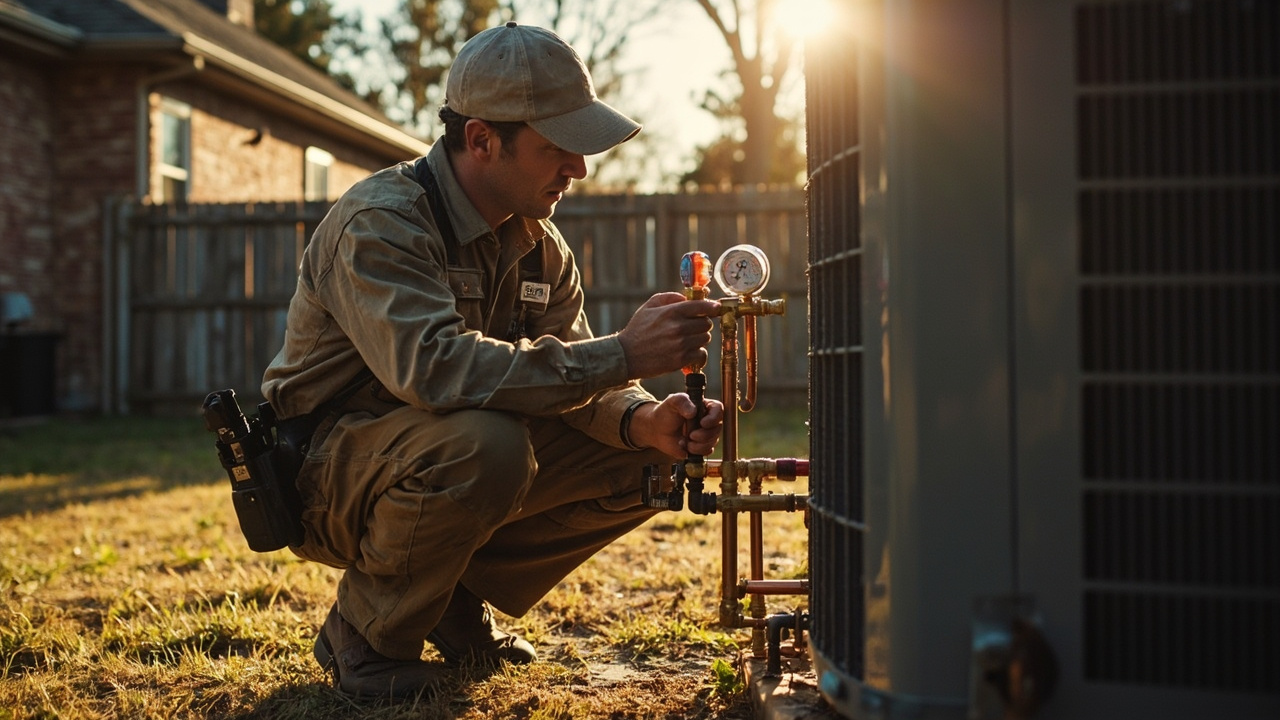
On the phone we ask what the system is doing, when it started, and how many times the breaker has cycled, since that distinguishes an electrical fault from an airflow or charge issue before anyone drives out. On site, the order stays the same every time. Filter, coil and return path get checked first, because a restriction there changes what every later reading means. Only after airflow is cleared does the visit move to the temperature split across the coil, and only after that does a gauge or an ammeter come out, so nothing gets read out of order and misjudged.
The repair itself
Once you approve the written scope, the system gets shut down at the disconnect before any panel comes off, so nothing is live while a capacitor, contactor or wiring connection is being replaced. The main operation depends on what the readings pointed to, whether that is a capacitor swap, a coil cleaning to restore airflow, or locating and repairing a refrigerant leak before recharging. If something turns up behind a panel that was not part of the original scope, like corroded wiring at the disconnect, we stop and show you before going further rather than deciding for you.
Proving it before we leave
Before the visit ends, the same delta T probes go back across the coil, and that reading has to land back in the range that means the coil is pulling heat out of the air correctly rather than starving or freezing. Amp draw on the compressor gets checked one more time against the rated load stamped on the data plate to confirm the new part is carrying the load without strain. We walk through what was found and what was replaced, and you keep the written record of both readings, before and after.
Why an unfamiliar crew slows down a Waco repair call
A crew unfamiliar with this area tends to treat every foundation the same, and that costs time. Older pier and beam houses have ductwork running through crawlspaces that move with the ground beneath them, and clay soil that swells and shrinks through wet and dry stretches pulls those duct joints apart at the seams rather than at the connections a newer slab house would fail at. A technician who assumes every attic duct system sits on a stable slab checks the wrong joints first and spends the visit chasing a leak that is not there.
Hail is another local condition that gets missed by anyone who has not worked outdoor units in this county before. A storm that bent condenser fins months ago can sit unnoticed until the unit is asked to run at full load, and a technician chasing an electrical fault without first looking at the coil face can spend an hour on a contactor when the real restriction is a fin bed pressed flat and cutting airflow across the outdoor coil.
Response across McLennan County during the hottest stretch of summer also runs differently than it does the rest of the year. When outdoor units across the county are all under the same run time stress at once, the crews answering calls need to already know which failures are common at which housing age so they are not learning the local pattern on the clock. Knowing that a 1970s slab house and a pre war pier and beam house fail at different points before ever pulling into the driveway is what keeps a same-day visit inside one visit instead of two.
A technician walking the property and recognizing these patterns from the start identifies where refrigerant charge has dropped, where airflow is blocked, and where the soil movement has already stressed the ductwork. That recognition stops the guesswork and keeps the diagnosis accurate the first time through. The difference between a crew that knows McLennan County and one that is seeing it for the first time shows up in the total time on the clock and in whether the repair holds.
More detail on carbon monoxide leak response is on its own page.
What working with us looks like on a same-day call
Same-day arrival and scheduling
On the phone we ask what the outdoor unit is doing, when it started, and whether the breaker has tripped once or more than once, since that sorts an electrical fault from an airflow or charge problem before a truck leaves. That tells us whether your call gets a same-day slot or a scheduled one, and you get a call back confirming the window once a technician is routed. If the visit ahead of yours runs long because of what its readings turned up, we call to move your window rather than let you wait without knowing.
Keeping your house clean during repair
Before a panel comes off the outdoor unit or the air handler, a drop cloth goes down under the work area to catch any refrigerant oil, dust or condensate that comes loose during the repair. Tools and replaced parts stay staged on that cloth rather than on the floor or the attic decking. Anything removed, an old capacitor, a section of coil fin, a failed contactor, leaves with the technician, and the last thing done before leaving is wiping down the panel and the immediate work area.
What moves the repair scope
A capacitor or contactor swap is a small part and a short visit. A coil replacement or a refrigerant leak that has to be located and sealed takes longer and changes the scope, and you see that written scope and approve it before the work starts. Timing moves cost too, since dispatch during the first stretch of sustained summer heat runs differently than a weekday visit in a milder week, because that is when every outdoor unit in the county is under the same strain at once and crews are answering calls back to back.
How a technician earns the truck
A new technician works alongside a lead on repair calls before being sent out alone, and the lead signs off only once that technician can read a delta T split and an amp draw correctly and explain what each one rules out. On anything that does not fit the usual pattern, a coil that iced with no clear airflow restriction, or a capacitor that failed early in a unit's life, a second technician looks at the readings before a scope gets written and approved.
You Have Questions,
We Have Answers
Most same-day calls resolve the same day. A weak capacitor, a failed contactor, or a plugged condensate drain are parts carried on the truck and get replaced once the readings confirm which one is at fault. A repair only slips past the same day when the fault is a refrigerant leak that needs locating, or when the readings point to a coil or compressor replacement that has to be scheduled.
A single-visit repair usually runs a few hours once the fault is confirmed. Diagnosis comes first, filter and airflow, then the delta T reading across the coil, then gauges or an ammeter depending on what that reading pointed to. A capacitor or contactor swap finishes quickly once identified, while a refrigerant leak repair takes longer because the leak has to be found and sealed before the system is recharged and tested.
Why Waco summers push same-day AC repair calls
Waco sits in a humid subtropical climate with long, hot summers and average highs in the mid to upper nineties through July and August, which means cooling equipment runs for many hours a day for months rather than cycling briefly through an afternoon. That run time is what exposes a marginal capacitor or a slow refrigerant leak that coped fine at lighter loads earlier in the season. The Gulf moisture that arrives in late spring and early summer adds a heavier humidity load on top of the heat load, which raises condensate volume and puts more work on drains that a dry winter never tests. Expansive Blackland clay under outdoor pads shifts through wet and dry stretches, which can tip a unit out of level and stress the refrigerant line connections at the pad over a season without any single failure event to point to.
Cooling repair calls in this metro peak in July and August, when weeks of sustained heat load expose the parts that were already marginal, and that is also when a same-day slot is hardest to hold open because everyone's equipment is under the same stress at once. Heating and heat pump calls run on a separate spike during short winter cold snaps, so the pattern is not steady across the year, it is two short peaks. Knowing which weeks the metro calls in at volume is part of why dispatch during the first serious heat wave gets scheduled differently than a repair call in April, and it is why a same-day promise made in June has to account for a queue that a same-day promise made in October does not.
HVAC Services in The Waco Area
Explore our service area and locate Granite HVAC Waco with ease. We're proudly local and serve the surrounding neighborhoods with fast response and honest pricing. Use the map to check our coverage area, or call us and we'll confirm in seconds.
Address:
Granite HVAC Waco, Waco, TX, 76701
Additional Services We Offer
- 24/7 Emergency AC Repair
- After-Hours HVAC Service
- Carbon Monoxide Leak Response
- Emergency Blower Motor Replacement
- Emergency Boiler Repair
- Emergency Commercial HVAC Repair
- Emergency Compressor Replacement
- Emergency Furnace Repair
- Emergency Heat Pump Repair
- Emergency Refrigerant Leak Repair
- Emergency Thermostat Replacement
- No Cooling Emergency Service
Changing filters on a set schedule, keeping the area around the outdoor unit clear, and rinsing condenser fins with the power off at the disconnect are genuinely homeowner tasks. Where it stops is refrigerant, anything behind the blower door, and anything inside the electrical panel, because those carry pressure and voltage that are not safe to work on without training. If what we find points to a compressor or coil replacement rather than a repair, we say so on the first visit rather than after work has started.
Before you call, know when the trouble started and whether it came on suddenly or built up over a few days. Check the breaker status and find the outdoor disconnect location if you can. Any age you have for the system helps, and knowing whether the filter was changed recently tells us a lot before we ever arrive.
Last reviewed September 2026 by Dale Whitfield, Service manager.