



When a blank thermostat screen is not the thermostat
A blank thermostat screen almost always means the low voltage circuit lost power, not that the thermostat failed. The 24 volt line that feeds the display runs through a float switch mounted in the condensate pan, and that switch is built to open the circuit the moment the pan fills past a set point. When it opens, the screen goes dark, the system stops calling for cooling or heat, and the hvac stops responding to thermostat commands even though nothing inside the thermostat has changed. A thermostat reading wrong temperature is a different fault, usually airflow or a sensor placement problem rather than a dead circuit.
Waco's cooling season runs from April or May through October, and July and August push the coil hard enough that the condensate system carries months of near constant moisture removal. That much runtime lets algae build inside a drain line that would stay clear in a shorter season, and a partly blocked line backs water into the pan faster than a homeowner notices. The humid stretch in late spring and early summer adds Gulf moisture on top of the heat load, raising the water volume the drain has to move every day the system runs. Float switch trips cluster in these months because the pan is filling more often, not because the switch itself is wearing out.
A thermostat not reaching set temperature while the screen still works points somewhere else entirely, usually restricted airflow at the coil or a return that cannot pull enough air to satisfy the sensor. That fault calls for an airflow check rather than a wiring trace, and treating it as a control failure wastes a visit. The distinction matters because a working thermostat with the wrong reading and a dead thermostat with a full pan behind it get fixed in opposite ways, and swapping the thermostat solves neither one.
A pan that has already tripped the float switch once will fill again unless the drain gets cleared. Left alone, the same pan overflows past the switch and into the platform beneath the air handler, and that water finds the ceiling below it. Once the ceiling stains, the drywall is already wet on the other side, and the rusted secondary pan underneath stops catching anything by the time the stain shows. A blank screen that keeps coming back after a reset is the point where the drain and the switch both need a look before the day is out.
Our page on furnace not igniting covers that side of the work in more depth.
The EPA's indoor air quality resources are the reference we point customers to on ventilation and filtration questions.

Find the sign you have, then read across to see whether it can wait.
| Symptom or first sign | What is already happening | What it becomes if ignored | When to call |
|---|---|---|---|
| A plugged condensate drain | The pan overflows into the platform or the ceiling | The ceiling below stains and the rusted secondary pan lets the rest through | Soon, before it spreads past the repair |
| A loaded filter | Airflow drops and the coil runs colder than it was designed | The coil ices over and the compressor takes liquid refrigerant back and fails | This week, while it is still one part |
| A cracked heat exchanger | Combustion gas mixes with the air being blown through the house | Carbon monoxide reaches the living space | Now, the same day |
How we trace a dead thermostat back to its actual cause
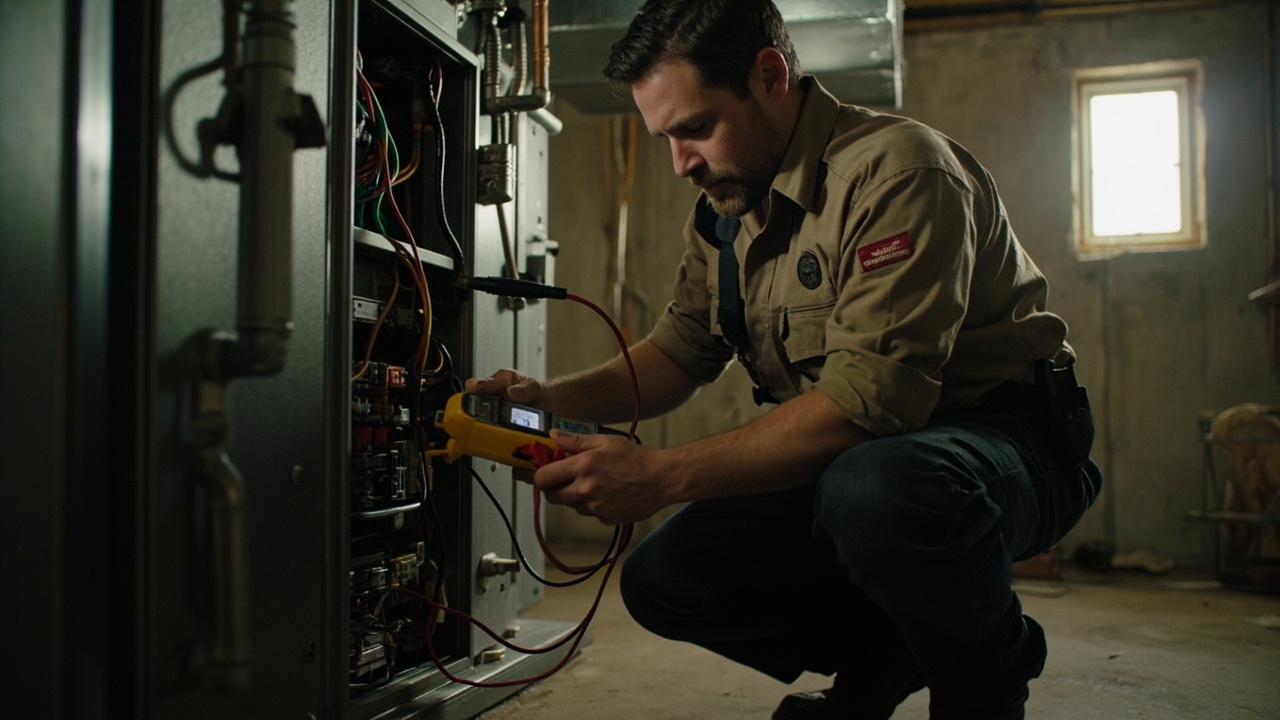
The visit starts at the condensate pan and the float switch, because that single check answers whether the low voltage circuit is intact before anyone touches the wall unit. The filter and coil get looked at in the same pass, since a fouled coil sheds more water than the drain was sized to carry and raises the odds of a repeat trip. Only after the pan is confirmed dry and the switch is confirmed closed does a voltmeter go on the thermostat wiring, checking for 24 volts at the terminals. If voltage is present but the screen stays dark, the fault has moved from the condensate side to the thermostat or the control board, and the wiring gets traced from there.
A dry pan with an open float switch means the water has already receded but the switch has not reset, which points at a mechanical stick rather than a live overflow. A wet pan with the switch still open confirms the drain is plugged and the trip is doing its job. Zero voltage at the thermostat with a dry pan and a closed switch shifts the search to the transformer, checked under load rather than at idle, since a weak transformer can read fine with the blower off and sag once the contactor and blower pull current together. Full voltage at the thermostat with a blank screen anyway means the fault sits inside the thermostat or, on newer equipment, in the compatibility between the thermostat and a communicating control board.
A single stage system only needs the thermostat to close a switch and send 24 volts to the right terminal, so nearly any replacement thermostat will run it. A zoned system or a communicating control board expects the thermostat to hold a specific protocol and stage sequence, and swapping in a generic replacement can leave the screen lit while the equipment ignores every call. That difference decides the repair before a part is ordered. A wiring fault or a float switch is a quick fix once found. A control board mismatch is a controls decision that has to match the equipment already installed, which is why communicating equipment gets checked before any thermostat gets bought.
If this sounds close but not quite your situation, emergency thermostat replacement may be the better starting point.
We install and service major brands like Carrier and register every unit to manufacturer specifications.
Ask which of these readings was taken before any part is replaced.
| Instrument | Good reading | Bad reading | What it changes |
|---|---|---|---|
| Filter, coil and condensate inspection | Light passes through the filter pleats, the coil fins are clean | A matted filter, a coil with ice on it | A homeowner who has never seen the inside of their air handler makes a different decision |
| Two probes for delta T between return and supply air | A 16 to 22 degree drop across the coil in cooling at normal indoor humidity | A small drop means airflow or charge is wrong | An unusually large drop means the coil is being starved of air |
| Manifold gauges with superheat and subcooling readings | Superheat and subcooling both landing in the range the equipment maker specifies for that metering device | High superheat with low subcooling | An undercharge or a restriction rather than a weak compressor |
How a thermostat call runs
Phone assessment and arrival
During the initial conversation we determine whether the screen darkened gradually or suddenly, and whether the outdoor unit continues running when it stops responding. These details help us distinguish between a condensate overflow and an electrical fault before dispatch. On site, the first step is checking the condensate pan and float switch position, since that single reading rules out or confirms the most common cause of a blank screen before the cover ever comes off the thermostat itself.
Diagnosis and your approval
Once the float switch and pan are cleared as a cause, or confirmed as the cause, we isolate power at the breaker before opening any low voltage wiring. Continuity gets tested along the run to the thermostat, and if a splice or a corroded terminal turns up, we show it to you before doing anything further. If the fault sits with the thermostat's compatibility with your control board rather than a wire or a switch, we walk through the replacement options and the setpoint range each one supports before any part is ordered.
Verification before we leave
Before the visit ends, we confirm voltage at the thermostat terminals holds steady with the system calling for cooling, and we check the temperature split at the coil, which should land in the 15 to 20 degree range on a system running normally. We walk you through what triggered the original fault, whether it was the drain, the switch or the wiring, and you keep a written note of what was found and what was done.
Why the housing stock around Waco changes how this gets diagnosed
A crew that does not work Waco regularly tends to assume every dead thermostat is the same repair, and the housing stock here makes that assumption wrong often enough to matter. Older wood frame houses on pier and beam foundations, common in the earlier construction eras around the city, often still run a 24 volt transformer system installed decades ago, and the wiring at the terminal block has usually been added to or spliced more than once as equipment changed hands. A wiring fault on that kind of run reads almost the same as a float switch cutoff on a meter unless the technician checks both before deciding.
Mid century ranch houses with the air handler and ductwork in the attic put the condensate pan directly above a finished ceiling, so a float switch that has been quietly failing does not just kill the thermostat, it sets up a slow leak that shows up as a stain days later. A crew unfamiliar with that layout that swaps the thermostat and leaves without checking the pan above it has fixed the symptom on the wall and left the actual water problem running in the attic.
Newer construction with a modern communicating control board is a different animal again. A thermostat pulled from an older house and reused on that kind of system will often power on and show nothing wrong while still failing to talk to the board, because the fault is protocol compatibility rather than voltage. Treating every blank screen the same way, instead of tracing the era of the wiring and the type of control board behind it, is how a thermostat gets replaced twice on the same house.
The work begins with establishing what generation of equipment is in place. Terminal block inspection reveals splicing history and voltage stability. Condensate pan location and float switch function get tested before any control board work starts. Protocol compatibility between thermostat and board gets verified on communicating systems before installation. This layered diagnostic approach catches problems that a standard swap misses, and it keeps a thermostat replacement from becoming a repeat service call.
More detail on ac not turning on is on its own page.
Permit and inspection questions? Commercial Construction Permits is the office we coordinate with on every permitted Waco job.
What to expect once you call about a controls fault
Same day scheduling
When you call, we ask when the screen went dark, whether the outdoor unit was still running, and whether the breaker has tripped. Those answers usually tell us if this is a same day visit or one that can wait for a scheduled slot. You get a confirmed arrival window before the call ends. If a job ahead of yours runs long because a wiring fault turned out deeper than expected, we call to move your window rather than leaving you guessing.
Careful work around the attic
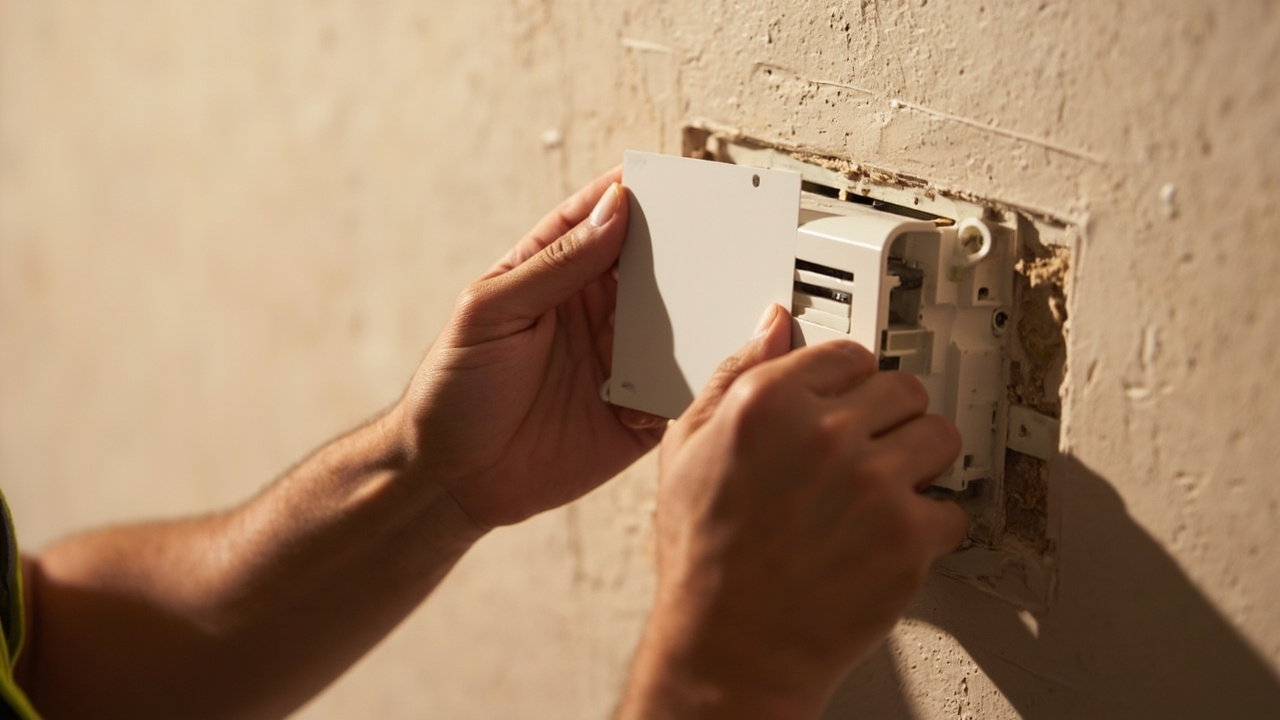
Before anything gets opened, we lay a drop cloth under the access point and stage tools so nothing sits on insulation or a ceiling joist. Checking the pan and float switch means working near standing water, so towels go down first and the area gets dried before we leave. Wiring traced through a wall plate gets the cover replaced and the plate reset flush. Nothing gets left open, and the space looks the way it did before we started, aside from whatever was repaired.
What moves the cost
The biggest swing on a controls call is whether the fix is a cleared drain and a reset switch or a thermostat that has to match a zoned or communicating system, since matched controls cost more than a basic replacement. Wiring age adds time if a run has been spliced more than once and each splice has to be checked. We write the scope after the pan, the voltage and the wiring are checked, and you see that scope and approve it before any part is ordered.
Checking a technician's work
A technician working controls calls alone has already run enough visits alongside a lead to demonstrate reading a float switch correctly and tracing a wiring fault to its source without guessing. The lead signs off on those specific tasks before the technician goes out solo. On a communicating control board or a zoned system, a second technician reviews the wiring diagram with the first before a thermostat gets ordered, since a mismatched replacement on that kind of system means a second visit that should not have been needed.
You Have Questions,
We Have Answers
A tripped condensate float switch usually cuts thermostat power before the thermostat itself fails. The same low voltage circuit can also be knocked out by a power surge when electricity returns after a winter storm outage, which strains the transformer that steps voltage down for the thermostat. Checking both before ordering a replacement thermostat avoids paying for a part that was never the problem.
A thermostat's lifespan depends on wiring condition and control board compatibility, not a fixed number of years. A unit riding on wiring spliced and rerouted over decades fails from a circuit fault long before its internal parts wear out. A newer communicating thermostat can go dead from a compatibility mismatch after a control board update rather than from wearing out at all.
The thermostat is working, but its sensor is reading air that does not match the room. A thermostat mounted near a supply register, a sunny wall or a doorway picks up warmer or cooler air than the rest of the house, so it satisfies early or runs long without the space catching up. Airflow restriction at the coil produces the same complaint, which is why the coil and the sensor location both get checked before any setting changes.
Most non responding thermostats have lost their 24 volt supply rather than failed internally. Dead batteries in a battery powered thermostat produce the same blank screen as a tripped float switch, so both get checked before either is called the cause. If the breaker has tripped, resetting it once is reasonable, but resetting it a second time after it trips again means the fault needs a look rather than another reset.
Why condensate volume drives thermostat calls in Waco
Waco's cooling season runs long, typically opening in April or May and holding through October, with July and August pushing the coil hardest. Months of near continuous moisture removal means the condensate system carries a heavier load here than it does in a place with a shorter cooling stretch, and the late spring and early summer months bring Gulf moisture that raises the latent load further. That extended runtime is exactly what grows algae in condensate lines, and it is why float switch trips cluster in the humid months rather than spreading evenly across the year. The same runtime also means a wiring fault at an aging terminal block gets exercised more often, since the circuit cycles more times per season here than in a shorter cooling climate.
What we check before closing out a controls call is whether the fix addressed the cause or just the symptom on the wall. Clearing a drain and resetting a float switch without confirming the pan drains cleanly afterward leaves the same trip waiting to happen again in a few weeks. On older wiring, we confirm the transformer output holds under load rather than just at idle, since a transformer that tests fine with the system off can sag once the blower and contactor are pulling current. Knowing that clay soils in this area shift foundations and can pull at wiring runs in pier and beam houses changes where we look for a loose connection first, which shortens the visit on that kind of house and prevents callbacks from the same root cause.
HVAC Services in The Waco Area
Explore our service area and locate Granite HVAC Waco with ease. We're proudly local and serve the surrounding neighborhoods with fast response and honest pricing. Use the map to check our coverage area, or call us and we'll confirm in seconds.
Address:
Granite HVAC Waco, Waco, TX, 76701
Checking thermostat batteries, resetting a tripped breaker once, and clearing a condensate line with water while the power is off are homeowner jobs, and you do not need us for those. The work stops at opening the low voltage wiring behind the wall or working inside the control board, since a wrong connection there can damage the equipment it runs. If a visit uncovers a wiring problem beyond the thermostat circuit, we say so before touching it further.
Before you call, know when the screen went blank and whether it happened suddenly or over a few days. Check whether the outdoor unit is still running and note if the breaker has tripped. If you can, look at the air handler for standing water in the pan below it. Any age you have for the thermostat or the system helps us know what to expect on arrival.
Last reviewed September 2026 by Dale Whitfield, Service manager.