





What that buzzing or humming outdoor unit is telling you
The sound usually shows up the same way. The outdoor unit hums, buzzes or clicks when it tries to start, sometimes catching and running rough, sometimes tripping the breaker and going quiet. It is not the compressor announcing itself. It is almost always an electrical component failing to do its one job, which is getting the compressor and condenser fan up to running speed the moment the thermostat calls.
A run capacitor stores the charge that kicks the compressor motor into rotation. When it weakens, the motor tries to start without enough push behind it, and what you hear is the motor straining against a load it cannot yet turn, over and over. A pitted contactor does something similar from the other end, chattering instead of closing cleanly, which produces its own buzz right before the unit either catches or quits.
Waco summers make this fault more common than it would be somewhere with a shorter cooling season. Highs sitting in the mid to upper nineties through July and August mean the outdoor unit runs for hours at a stretch, day after day, and that near constant cycling is what shortens the life of a run capacitor faster than age alone would. A capacitor that would have lasted through a milder season fails mid summer here, right when the system is asked to work hardest.
Left alone, the fault does not stay small. A weak run capacitor makes the compressor pull high amps on every single start attempt. Those repeated high amp starts heat the motor windings past what they are built for, and a part that could have been swapped in an afternoon turns into a compressor that has to be replaced along with the rest of the condensing unit. That point, motor windings overheating from repeated hard starts, is where a buzzing noise stops being an annoyance and becomes the reason to call today rather than next week.
The difference between a quick repair and a major replacement often comes down to timing. Catching the buzzing, humming or clicking sound early means addressing the electrical component while the motor itself is still sound. Waiting through even one more week of high demand operation in peak summer heat multiplies the stress on motor windings with every restart cycle.
See after-hours hvac service for how the related work is scoped and priced.
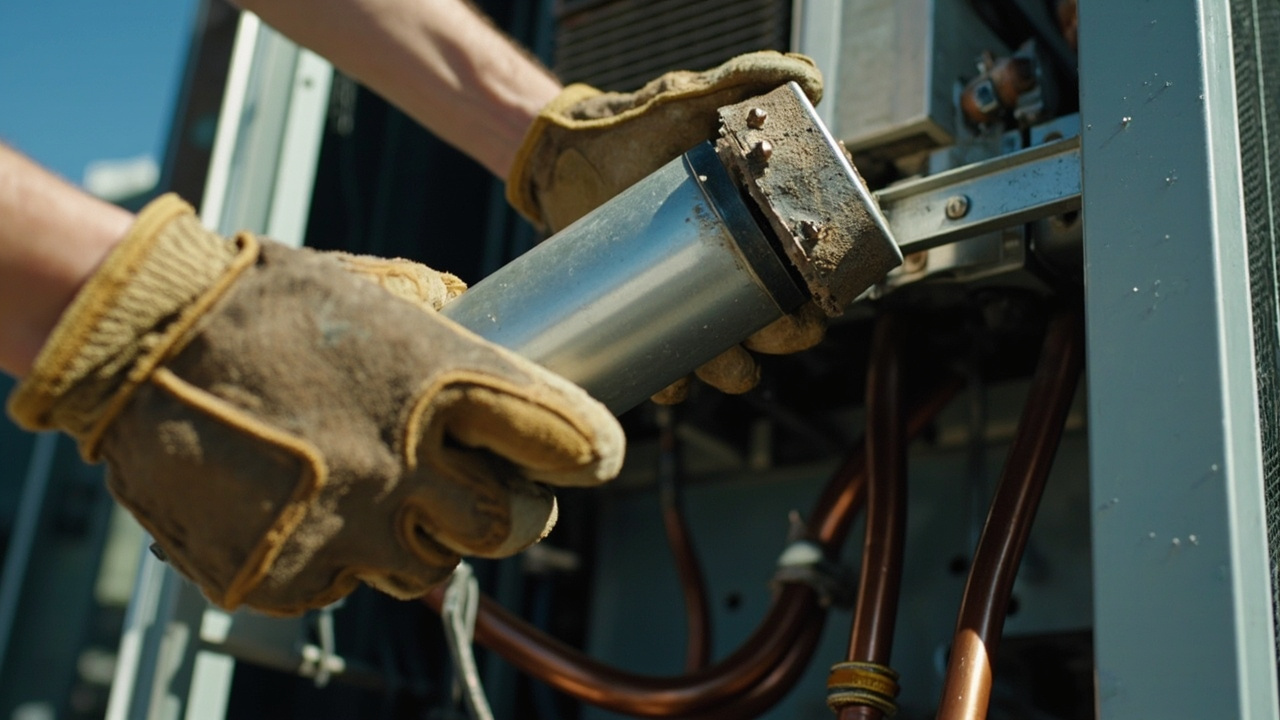
Find the sign you have, then read across to see whether it can wait.
| Symptom or first sign | What is already happening | What it becomes if ignored | When to call |
|---|---|---|---|
| A weak run capacitor | The compressor pulls high amps every time it tries to start | The windings overheat and what was a part becomes a whole condenser | Now, the same day |
| A cracked heat exchanger | Combustion gas mixes with the air being blown through the house | Carbon monoxide reaches the living space | Now, the same day |
| A slow refrigerant leak | The system runs longer for less cooling and oil stops circulating properly | The compressor loses lubrication and seizes | This week, while it is still one part |
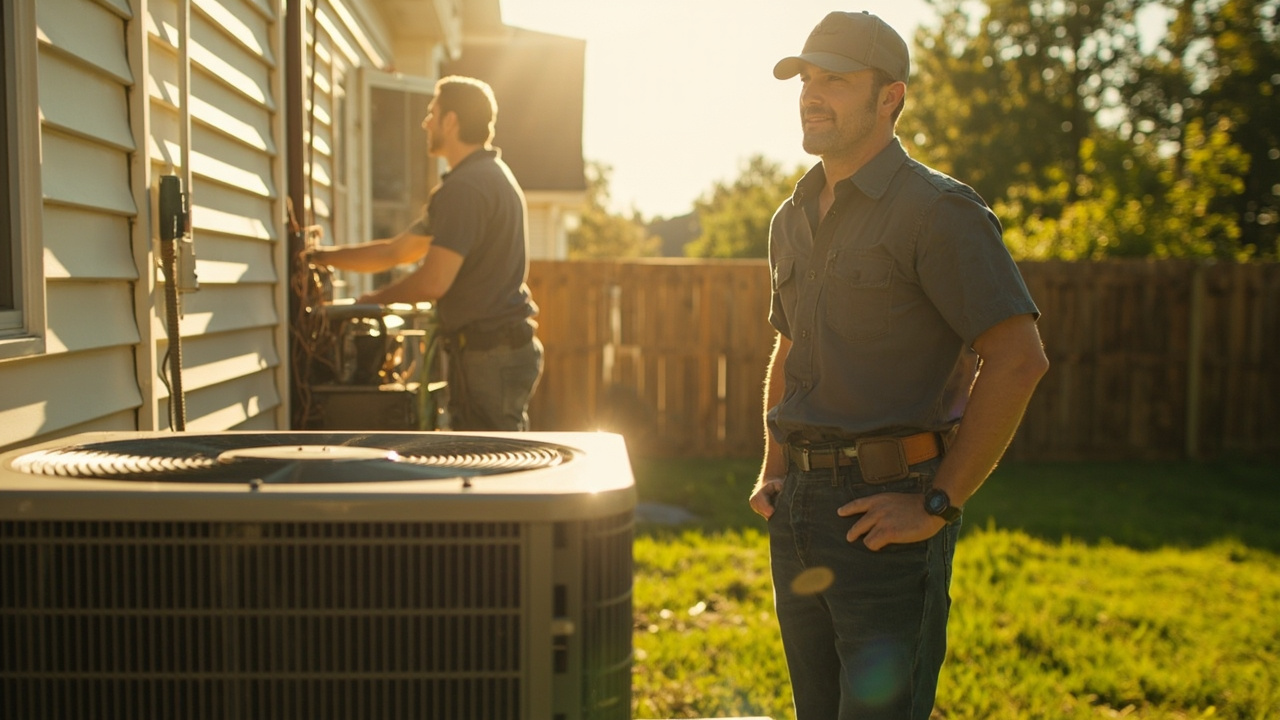
How we read the amps before we name the part
The visit starts with the unit doing exactly what you described on the phone, humming, buzzing or clicking, so we watch and listen through a full start attempt before touching anything. That tells us whether the fault sits at the capacitor, the contactor, the condenser fan motor or somewhere behind them, because each one has a slightly different sound and timing at the moment of start.
The clamp ammeter goes on next, reading the compressor and the blower against the rated load amps stamped on the equipment data plate. That single reading decides the whole visit. Amps sitting at or below the rated load with a clean start means the electrical side is healthy and the noise has another source. Amps running high on every start, or spiking toward locked rotor before the unit catches, points straight at a weak run capacitor or a failing contactor, and it rules out the compressor itself as the cause before anyone talks about replacing one.
This is also the line between a part and a system decision. A capacitor, a contactor or a condenser fan motor is a part, and a bad amp reading on any of those is a same visit repair. A compressor pulling high amps with the capacitor already tested good is a different conversation, because at that point the fault is inside the sealed circuit rather than outside it, and that changes what gets quoted.
Once we know whether the problem is electrical or mechanical, the next step is checking the refrigerant charge against the nameplate specifications. An undercharged system will show low amps on the compressor draw and high discharge pressure, because the motor is working harder to move less refrigeant through the circuit. An overcharged system does the opposite, pushing the compressor into high amp draw with nowhere for the extra pressure to go. Either condition degrades efficiency and shortens the life of the compressor, so the charge is corrected before any sealed circuit repair gets quoted.
More detail on commercial hvac contractors is on its own page.
Ask which of these readings was taken before any part is replaced.
| Instrument | Good reading | Bad reading | What it changes |
|---|---|---|---|
| Clamp ammeter on the compressor and the blower | Running amps at or below the rated load amps stamped on the data plate | Amps steady above the rating, or a brief spike toward locked rotor on start | A failing capacitor, contactor or compressor |
| Manifold gauges with superheat and subcooling readings | Superheat and subcooling both landing in the range the equipment maker specifies for that metering device | High superheat with low subcooling | An undercharge or a restriction rather than a weak compressor |
| Micron gauge during evacuation | Below 500 microns and holding there after the pump is valved off | A reading that climbs back up | Moisture is still boiling off inside or the system is not sealed |
| Manometer for total external static pressure across the air handler | Static pressure at or under the maximum printed on the blower data plate | Static above the rating | The filter, the coil or the duct is choking the system |
How a noise complaint call runs
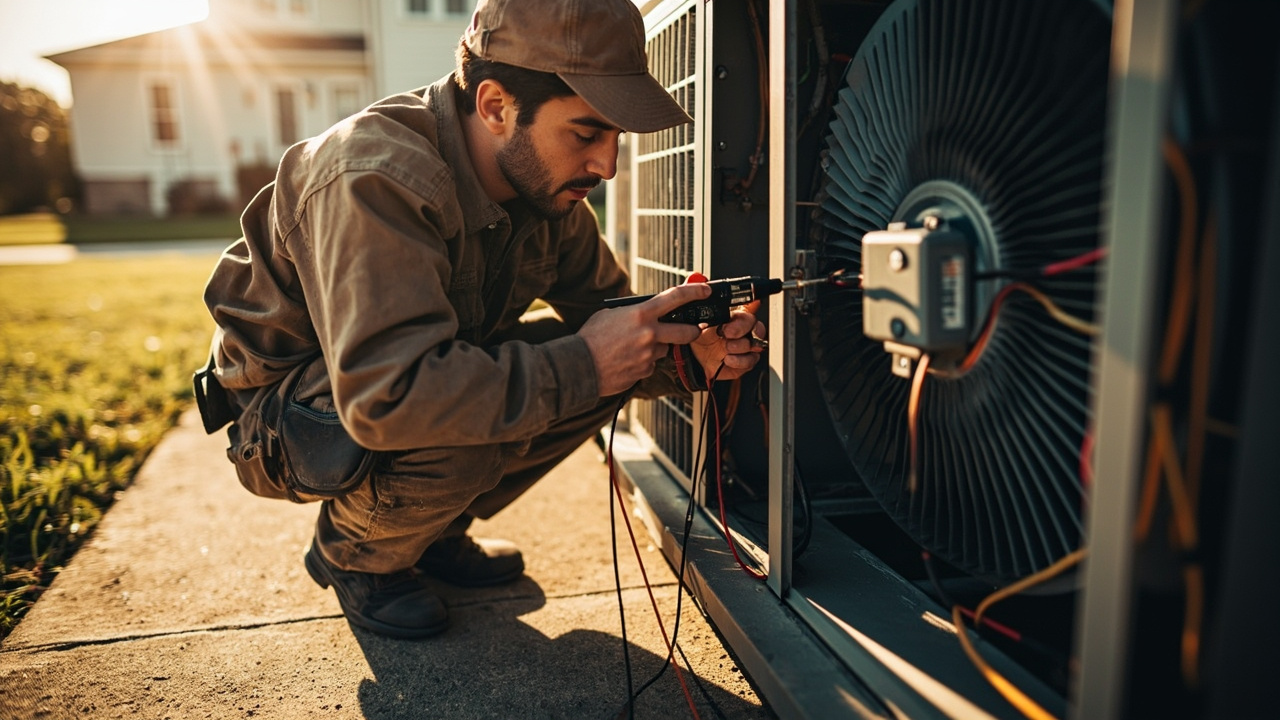
The call and the first listen
On the phone we ask when the sound started, whether it happens every time the unit tries to start or only sometimes, and whether the breaker has tripped. Those answers point us toward an electrical fault before anyone arrives. On site, the technician watches a full start attempt first, listening for exactly where in the cycle the buzz, hum or click happens, because a sound at the moment of start points somewhere different than one that continues while the unit is running.
Testing before touching a part
Once the sound is placed in the start cycle, the disconnect comes out and the clamp ammeter goes on the compressor and blower during a controlled start attempt. If the reading points to the capacitor or contactor, that part gets replaced the same visit in most cases. If the amps stay high with the capacitor testing good, we stop and show you the reading before writing up anything involving the compressor itself, since that is a different scope entirely.
Confirming the fix before we leave
After the repair, the clamp ammeter goes back on the compressor and blower for another start attempt, and the reading has to land at or below the rated load amps on the data plate with no spike toward locked rotor. We run the unit through a couple of full cycles to confirm the buzz or hum is gone rather than just quieter, walk you through the readings before and after, and leave you with the rated load amps noted so you have a number to compare against if the sound ever returns.
Why access shapes this repair more than the noise does
A capacitor or contactor swap is usually quick once the fault is confirmed, but what makes one Waco house take longer than another is not the wiring, it is getting to the unit. Older housing stock built before central cooling was standard often has the condenser tucked against a foundation with limited clearance on every side, and post war ranch houses frequently put the disconnect and wiring in spots that were never meant to be serviced often. None of that changes the diagnosis, but it changes how much time the visit takes once the part is identified.
A crew unfamiliar with how these older systems were retrofitted tends to assume every outdoor unit sits on an open pad with full access on all sides. That assumption costs time when the disconnect is buried behind landscaping that has grown up around it over the years, or when the wiring run to the unit was extended at some point and now has to be traced before anyone can safely pull power. Working this housing stock regularly means expecting that and building it into the visit rather than discovering it partway through.
The other local factor is what the ground does to the pad itself. Expansive clay soil around Waco shrinks and swells with the weather, and outdoor units set on pads that have shifted over years of that movement sometimes sit slightly out of level, which stresses the electrical connections at the disconnect box even before a capacitor starts to fail. A technician who checks the pad along with the amps is looking at the whole reason the unit is buzzing, not just the part that finally gave out.
That foundation movement also affects how long a replacement takes. Settling pads force crews to account for new angles when positioning equipment and running conduit, and corrosion accelerates on connections that rock slightly with every seasonal cycle. The visit extends because the technician is measuring what the soil has done, not just swapping hardware.
If this sounds close but not quite your situation, hvac short cycling may be the better starting point.
Your local utility, Utility Bill City of Waco, publishes service and water-quality information every Waco homeowner should know.
What the visit looks like once you call
Getting to your door quickly
You describe the sound and when it started, and we ask whether the unit is starting at all, cycling on and off, or tripping the breaker. Those answers tell us whether this is a same day visit or one that can be scheduled for later in the week. You get a confirmed arrival window before we hang up. If the job ahead of yours runs long because of what got found there, we call to reset the window rather than leaving you guessing.
Working around your property
Before the outdoor unit is opened, the disconnect is pulled and the panel is set aside somewhere it will not get stepped on or lost in the grass. Any landscaping or debris blocking clean access to the unit gets moved rather than worked around. Tools stay staged on a mat next to the unit rather than scattered across the yard, and once the amp readings are taken and the part is swapped, the panel goes back on and the area is left the way it was found.
What changes the price
A capacitor or contactor swap on a unit with clear access is a straightforward job. Cost moves with access and rigging instead, meaning whether the disconnect and wiring sit somewhere open or somewhere tight, behind landscaping, up against a foundation wall, or wired through a run that has to be traced first. The scope gets written after the amp reading confirms the part and after access is checked, and you see and approve that written scope before anything is repaired.
Who is doing the work
A technician runs a set number of visits alongside a lead before working outdoor electrical faults alone, and the lead signs off specifically on reading a clamp ammeter correctly against a data plate before that technician handles one solo. On anything where the amp reading does not clearly point to one part, a second technician reviews it before a repair gets written up, rather than a single guess deciding the scope.
You Have Questions,
We Have Answers
A failing compressor itself is rare, usually a deep, labored hum that continues once the unit is running rather than only at start. Most buzzing or humming at start is a weak run capacitor or a pitted contactor. A clamp ammeter reading against the nameplate specification is what tells the two apart before any part gets replaced.
A loud, revving drone at the outdoor unit is usually the compressor trying to start against a weak capacitor, pulling high amps in short bursts that sound like an engine struggling to catch. Granite HVAC Waco reads that with a clamp ammeter against the data plate rated load before naming the part, which is why the same call rarely turns into a guessed compressor replacement. Call (254) 221-8461 to get it read.
Why Waco summers wear this part out first
A run capacitor fails from cumulative strain, and Waco gives it more of that strain than a milder climate would. The outdoor unit starts and runs for hours at a stretch across the whole cooling season, which runs from roughly April through October here, with afternoon temperatures regularly reaching the mid to upper nineties during peak months. Every one of those starts asks the capacitor to deliver its charge cleanly, and the ones that add up fastest happen on the hottest afternoons, which is also when a homeowner is least willing to have the system down. The expansive clay soil under much of the area adds a second strain, since outdoor pads shift as the clay dries and swells with the weather, and a unit sitting slightly out of level puts uneven stress on the wiring connections at the disconnect even before the capacitor itself weakens.
Inspection on a repair like this looks at what the disconnect box and the wiring were doing before the fault, not just the new part going in. An inspector checking mechanical work wants the connections at the disconnect landed cleanly and the panel seated the way it was before anyone opened it, since a loose termination left behind is what turns a clean capacitor swap into a callback. Knowing that up front changes how the panel gets handled during the visit, down to torquing each connection back to spec rather than snugging it by feel. That habit matters more in McLennan County than it would somewhere with stable soil, since a pad that has shifted even slightly can leave a connection stressed in a way that looks fine until the unit runs a full cycle under load. Checking that stress at the disconnect, not only the amp draw at the compressor, is what keeps a repair from becoming a second visit.
HVAC Services in The Waco Area
Explore our service area and locate Granite HVAC Waco with ease. We're proudly local and serve the surrounding neighborhoods with fast response and honest pricing. Use the map to check our coverage area, or call us and we'll confirm in seconds.
Address:
Granite HVAC Waco, Waco, TX, 76701
Checking your breaker and confirming the outdoor disconnect is switched on are genuinely things you can do yourself before calling. Where it stops is anything past that disconnect, since a clamp ammeter reading and a capacitor swap both involve live electrical components behind a panel that should not be opened without power confirmed off. If what we find points to a fault inside the sealed refrigerant circuit rather than the electrical side, we say so on the first visit.
Before you call, know whether the sound happens on every start cycle or intermittently, and whether the breaker has tripped. Note roughly when it started and whether the unit is cooling normally between the noises. If you know the age of the outdoor unit, have that ready too. Those answers tell us whether this needs someone today.
Last reviewed September 2026 by Dale Whitfield, Service manager.