




What it means when your AC never shuts off
A homeowner calling about this rarely says the compressor failed. They say the unit never shuts off, the fan runs from morning to night, and the thermostat still will not touch the number on the dial. Some describe an air conditioner that runs all day and never seems to catch up, others just want to know why their AC won't stop running when the bill just came in higher than last month's.
The first question a technician has to answer is whether that runtime is the system working as designed or the system failing quietly. On a stretch of afternoons near a hundred degrees, a correctly sized system can spend nearly the entire day cycling to hold the house steady, and that alone is not damage, it is the equipment keeping pace with the heat load outside. What separates normal long runtime from a failing system is whether the house is holding temperature. If the thermostat reads close to setpoint and stays there, the unit is working hard and winning. If the reading keeps drifting upward through the afternoon no matter how long the compressor runs, the AC can't keep up with the heat for a reason that needs to be found rather than accepted.
Extended stretches of high outdoor temperature push outdoor units into something close to continuous operation for weeks at a stretch, and that kind of sustained load is what exposes a weak run capacitor, a pitted contactor or a compressor that has been quietly losing lubrication long before it ever trips a breaker. None of those failures announce themselves with a loud noise. They show up first as runtime that creeps a little longer every week.
One pattern deserves particular attention because it hides behind normal seasonal runtime for a while before it does not. A slow refrigerant leak lets the system run longer while cooling less, and as the charge drops further, oil that is supposed to circulate with the refrigerant stops moving the way it should. Left alone, that starved lubrication is what lets a compressor seize rather than simply wear. A unit that has been running long all summer and starts running noticeably longer for the same result, with a bill that keeps climbing past what the heat alone explains, is past the point where waiting makes sense.
See ac not turning on for how the related work is scoped and priced.
How we tell a working system from a failing one
The order matters more than any single reading. A technician starts at the filter, the return grille and the indoor coil, because a restriction anywhere in that path will make a perfectly charged system look weak. Next comes total external static pressure against the blower's data plate, which rules the duct in or out as the reason the system cannot keep up. Only after airflow is confirmed clean does a temperature split across the coil and a set of refrigerant readings mean anything, because a charge number taken behind a dirty filter is a guess wearing a decimal point.
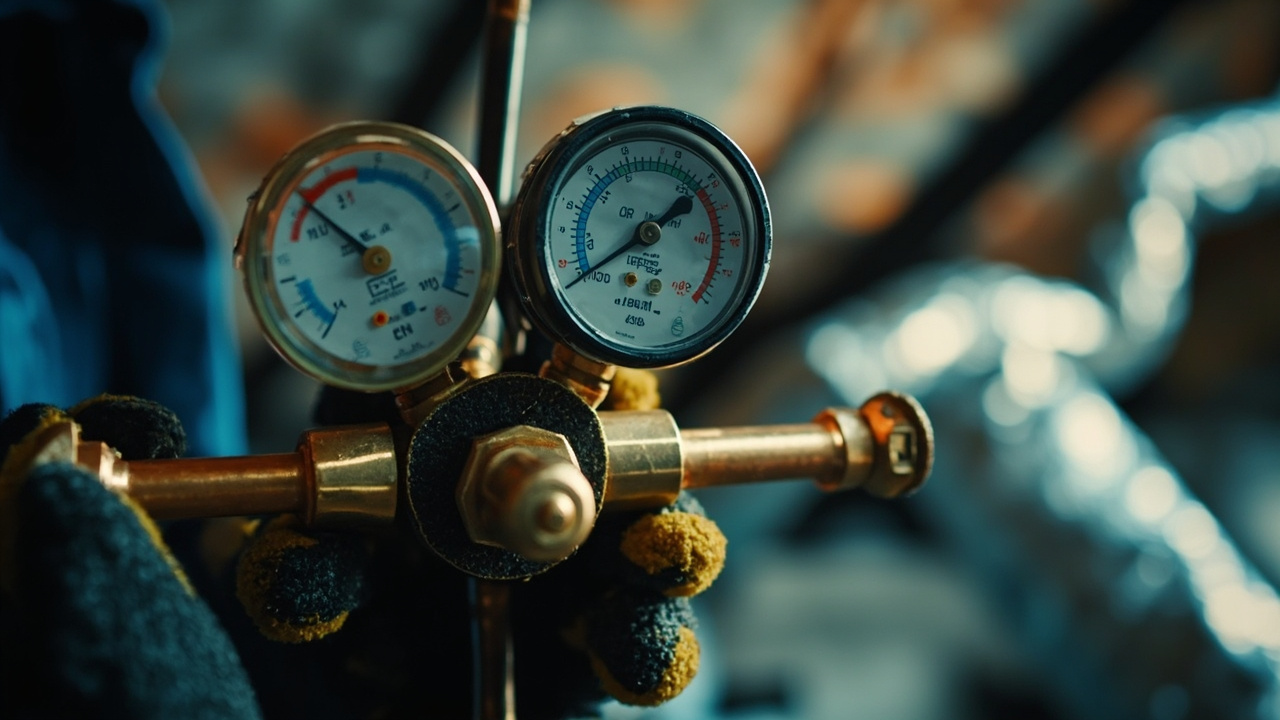
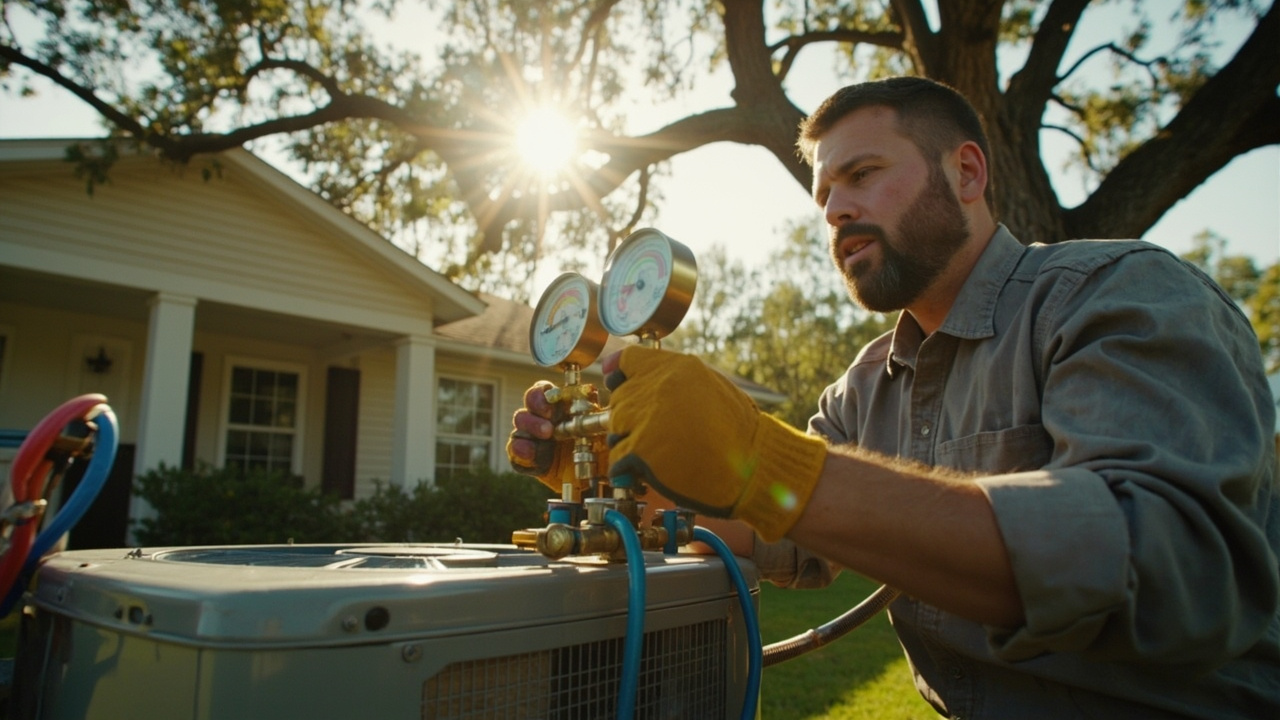
The reading this page turns on is superheat and subcooling, taken with manifold gauges at the service ports. What the target looks like depends on what is metering the coil, a thermostatic expansion valve is judged mostly on subcooling and a fixed orifice system is charged on superheat, so there is no single number that applies to every unit. High superheat paired with low subcooling points at an undercharge or a restriction, which is the leak pattern behind a system that runs long and still runs warm. A different pattern, both readings closer to normal but amperage climbing on the compressor and the blower, moves the fault away from the refrigerant circuit entirely and toward a weak capacitor or a strained motor.
Runtime itself is a comparison question as much as a repair question. A single stage condenser has one speed, full on, so on a hundred degree day it runs close to continuously by design and that runtime tells you little on its own. A two stage or variable capacity condenser spends most of a hot day at reduced capacity, running longer at low speed rather than cycling on and off at full speed, which pulls more moisture out of the air and runs quieter measured in decibels. A single stage system that seems to run forever compared to a neighbor's variable capacity unit may simply be an older compressor doing the only thing it knows how to do.
Our page on ac blowing warm air covers that side of the work in more depth.
Permit and inspection questions? Commercial Construction Permits is the office we coordinate with on every permitted Waco job.
Ask which of these readings was taken before any part is replaced.
| Instrument | Good reading | Bad reading | What it changes |
|---|---|---|---|
| Manifold gauges with superheat and subcooling readings | Superheat and subcooling both landing in the range the equipment maker specifies for that metering device | High superheat with low subcooling | An undercharge or a restriction rather than a weak compressor |
| Micron gauge during evacuation | Below 500 microns and holding there after the pump is valved off | A reading that climbs back up | Moisture is still boiling off inside or the system is not sealed |
| Manometer for total external static pressure across the air handler | Static pressure at or under the maximum printed on the blower data plate | Static above the rating | The filter, the coil or the duct is choking the system |
| Flame sensor signal check in microamps | A steady signal well above the control board dropout point | A weak or drifting signal | The sensor is coated and the burner will drop out |
| Two probes for delta T between return and supply air | A 16 to 22 degree drop across the coil in cooling at normal indoor humidity | A small drop means airflow or charge is wrong | An unusually large drop means the coil is being starved of air |
How a diagnostic visit runs
First call and initial check
On the phone we ask what the thermostat is set to, how long the runtime has stretched on, and whether anything changed just before it started, a new filter, a storm, a breaker trip. On site we inspect the filter, return grille and indoor coil first, since a blockage at any of these points can account for the entire complaint before instruments are deployed. Thermostat mode and fan setting get confirmed next, since a fan left on continuous or a mode set wrong reads exactly like a failing system from the vents.
Testing and the repair
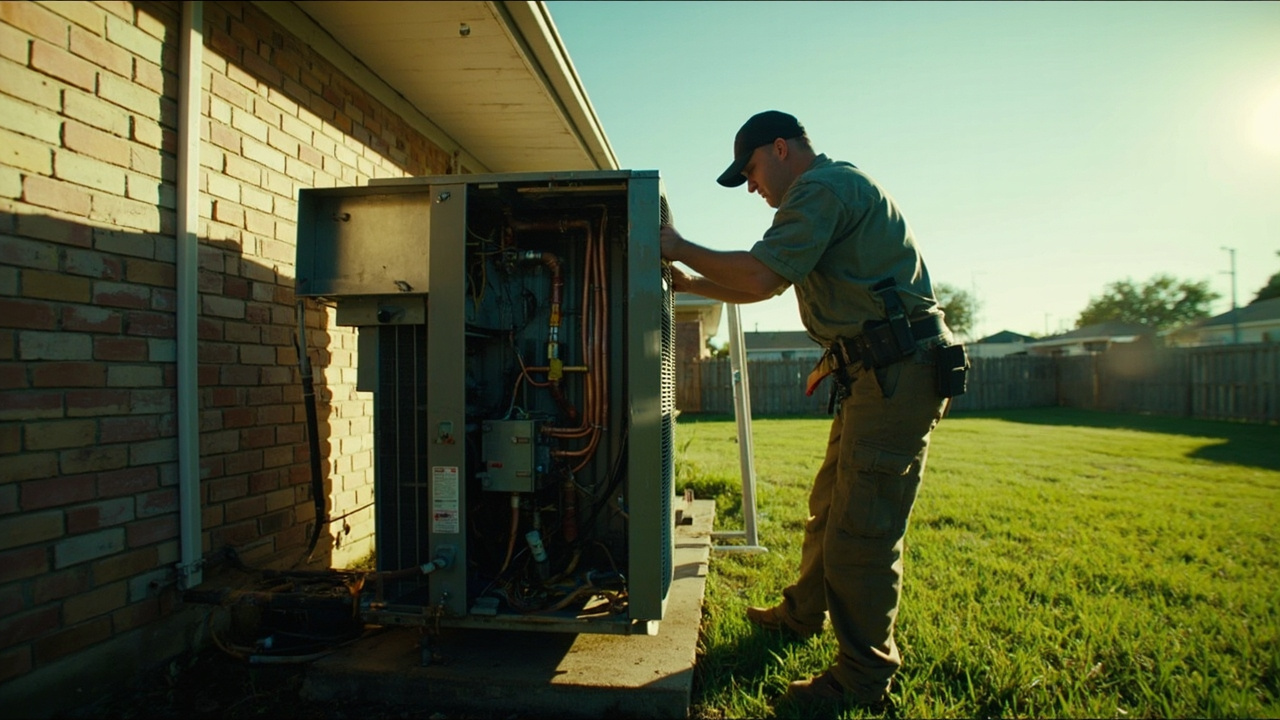
Once airflow is cleared, static pressure and the temperature split across the coil narrow the fault to the duct, the coil or the charge. If the readings point at refrigerant, the leak gets found rather than papered over, repaired, the filter drier changed, and the system pulled down to a vacuum before any refrigerant goes back in. If the fault turns out to be electrical, a capacitor or contactor gets confirmed on the meter before it is replaced. Anything unexpected found behind the panel gets shown to you before work continues.
Verification before we leave
Before the visit ends, the manifold gauges go back on and the superheat or subcooling reading has to land where the metering device on that equipment calls for, and amp draw on the compressor and blower gets checked against the data plate rating. We walk you through what the reading showed and what it ruled out, and you keep a note of what was measured and what was done, which matters the next time runtime climbs and someone needs to know what the system looked like this time.
Why long runtime reads differently in Waco
A crew that mostly works in a milder climate tends to treat any AC that runs for hours without stopping as evidence of a fault, because where they come from it usually is. In Waco, months of highs in the mid to upper nineties mean long runtime is the expected behavior of a correctly sized system, not a symptom by itself. Reading it as a fault leads to a charge added to a system that was never low, which does nothing for the house and can push a properly filled system into an overcharge that raises head pressure and shortens compressor life.
Housing age changes where the actual fault tends to hide. Ranch style houses from the mid century decades put the air handler and the ductwork in the attic, where summer heat adds duct gain to a system that is already working against a heavy load, so airflow at the register can read weaker than the coil itself would suggest. Older wood frame houses built on raised, pier and beam floors often have ductwork added after the house was built, running through crawlspaces or shallow attics with a return path that was never sized for continuous cooling. A crew unfamiliar with that pattern checks the outdoor unit first and misses that the real limit is a starved return two rooms away.
McLennan County's Blackland clay soil adds a wrinkle that does not exist everywhere. It shrinks in drought and swells when wet, and that movement shifts outdoor pads and stresses the rigid connections at the line set and the foundation over the years the unit has been in service. A joint stressed that way is a plausible source of the slow leak affecting a system running extended cycles with reduced cooling capacity, which is one more reason the refrigerant circuit gets checked with gauges rather than assumed clean because the unit is only a few years old.
If this sounds close but not quite your situation, ac leaking water may be the better starting point.
What to expect once you call
Getting someone to your door
On the call we ask how long the system has been running without a break, what the thermostat is set to, and whether anything changed right before the runtime stretched out. Those answers tell us whether this is a same day visit or one that can be scheduled for a quieter slot. You get a window rather than a vague promise, and if the job ahead of yours runs long, we call and reset the time before you are left wondering.
Keeping your home as found
Before a panel comes off the air handler or a gauge line goes on the service port, the work area gets a drop cloth and the immediate space around the equipment gets cleared. Any condensate or refrigerant residue stays contained rather than spreading to the floor or the attic decking around it. Tools stage on the covering, not on your flooring, and the last step before we leave is putting the access panel back and clearing the area of everything we brought in.
What moves the cost
If this ends in a repair, the part and how hard it is to reach set most of the number. If it ends in a look at replacement, the biggest question is whether your existing ductwork can move the air new equipment would need, which the static pressure reading against the blower data plate answers directly rather than by guess. That reading, along with what the coil and charge diagnostics turn up, becomes a written scope you see and approve before anything is ordered or installed.
Who is working on your system
A technician new to the board spends time running diagnostics alongside a lead before working a call alone, and has to demonstrate reading manifold gauges correctly and interpreting a static pressure test before that sign off happens. On anything unusual, a system that has been charged before without the leak being found, for instance, a second technician looks at the readings before a scope gets written, so the call is not one person's guess against the clock.
You Have Questions,
We Have Answers
It can be normal on a hundred degree day if the house is holding temperature. Waco summers push correctly sized systems into nearly continuous operation for weeks, so long runtime alone is not proof of a fault. What matters is whether the return to supply air temperature split still lands in the normal 15 to 20 degree range, since a drop well outside that band points to a real problem rather than heat load alone.
It is usually heat load, restricted airflow, or a refrigerant leak, checked in that order. A technician clears the filter, coil and return path first, then verifies the blower is moving air at rated capacity before touching a gauge, because duct restriction alone can produce runtime that looks exactly like a charge problem.
Not by itself, but it depends on what is causing it. Refrigerant is not consumed in normal operation, so if gauge readings show the charge is low, that is a leak somewhere in the circuit rather than something the system used up, and running long on a low charge is what starves the compressor of oil and eventually seizes it.
No, that is short cycling rather than the long steady runtime a hot afternoon produces, and it points to a different problem. A compressor restarting that often often shows a climbing amp draw on the clamp meter with each attempt, which is the pattern of a failing run capacitor or contactor rather than a system simply working through heat.
Why Waco heat keeps AC units running nonstop
Waco's cooling season runs from spring into October, with July and August holding highs in the mid to upper nineties for weeks at a time, which is long enough that a correctly sized system spends most of the day running just to hold the house steady. Attic mounted ductwork common in mid century ranch houses and newer construction alike picks up heat from that attic air on its way to the register, adding duct gain on top of the load the equipment already has to beat. Underneath all of it, McLennan County's Blackland clay expands and contracts through the season, moving the outdoor pad and straining the line set connections below grade, a mechanism that can produce refrigerant loss in systems that run extended cycles, which is why a gauge check matters rather than assuming the equipment is simply working hard.
Diagnostic work on a running system does not involve a permit, but the same discipline that a permitted job demands still applies to the readings taken here. Waco's peak cooling months bring the highest call volume of the year, and that volume is exactly when a weak capacitor or a strained contactor is most likely to show up on the meter, because the equipment has been running under sustained load for weeks rather than cycling normally. Verifying amp draw against the compressor's data plate rating during that stretch catches a component drifting toward failure before it trips a breaker on the hottest afternoon of the season. Recording the return to supply temperature split, which should land somewhere in the 15 to 20 degree range on a normal system, against what the gauges show at the same visit keeps one reading from being read in isolation and gives you a record of what the system looked like this time if runtime climbs again later in the season.
HVAC Services in The Waco Area
Explore our service area and locate Granite HVAC Waco with ease. We're proudly local and serve the surrounding neighborhoods with fast response and honest pricing. Use the map to check our coverage area, or call us and we'll confirm in seconds.
Address:
Granite HVAC Waco, Waco, TX, 76701
Changing filters on schedule, keeping a couple of feet clear around the outdoor unit, rinsing the condenser fins with a hose from the inside out with power off, and checking the thermostat batteries and the breaker are genuinely homeowner jobs. Where it stops is refrigerant, anything behind the blower door, and anything inside the electrical panel, because those carry pressure and voltage that are not safe to work on without training. If what we find crosses that line, we say so on the first visit.
Before you call, know roughly when the constant running started and what changed just before it. Check whether the thermostat fan is set to auto rather than continuous, and know the rough age of the outdoor unit if you have it. Those answers usually tell us whether this needs someone today or can wait for a scheduled visit.
Last reviewed September 2026 by Dale Whitfield, Service manager.