




What weak airflow from vents is telling you about the system
A vent that used to push air across the room and now barely stirs a curtain is telling you the system is moving less air than it was built to move, not that it stopped working entirely. Sometimes it is one register in one room. Sometimes every vent in the house feels weak at once, and the thermostat still shows the system running. Either way the air handler is trying to push the same volume through a path that has narrowed somewhere between the return grille and the register.
In Waco that narrowing has a seasonal pattern. Cooling season here runs long, often from April into October, with July and August pushing the blower harder for more hours than at any other point in the year. A filter that was fine in March loads up faster once the system is running most of the day, and a coil that was clean in spring can pick up dust just as fast under that runtime. Humidity from Gulf moisture in late spring and early summer adds to the load on the coil at the same time, so a system already fighting a dirty filter is also fighting more moisture than it was sized for.
What that combination does to the equipment is direct. A loaded filter restricts the air moving across the evaporator coil, so the coil runs colder than it was designed to run. Run it long enough in that state and the coil starts icing along the fins instead of just cooling the air passing over them. Once ice forms, it blocks even more of the airflow the compressor depends on, and the compressor starts pulling back liquid refrigerant instead of vapor. A compressor built to compress gas is not built to swallow liquid, and that is the point where a weak vent complaint turns into a failed compressor rather than a fixed filter.
That is the line worth knowing before you decide whether to wait. Weak airflow on its own is an inconvenience. Ice on the coil or on the line set outside, air that has gone from weak to barely present, or a system that now runs constantly without the house cooling down are signs the coil has already started icing, and every additional hour of runtime in that state moves the job from a filter change toward a compressor replacement.
If this sounds close but not quite your situation, ac constantly running may be the better starting point.


How we trace weak airflow before we touch a duct
The order matters more than any single reading. We start at the filter and the return grille, since a loaded filter or an undersized return starves the whole system before a single tool touches the outdoor unit. From there we look at the evaporator coil itself for ice, dirt on the fins, or a condensate pan that has backed up and is drowning airflow from underneath. Only once the filter, the coil and the return path are cleared do we put a manometer on the air handler and read total external static pressure, because a charge number taken before airflow is known tells you nothing true.
That static pressure reading is the one this job turns on. Read against the blower data plate's rated maximum, it tells us whether the existing duct can move the air this system was built to move, or whether something in the duct itself, a crushed run, an undersized trunk, a return that was never sized for the equipment, is the actual restriction. That single reading decides the fork in the job. If static pressure comes back inside the rated range, the fix is upstream, at the filter, the coil or a register that got closed off. If it comes back high, no amount of cleaning or charging solves the complaint, and the duct itself is what has to change.
Where a room stays starved even after the duct is corrected, the comparison worth having is on filtration. A one inch pleated filter caught in a slot never sized for it adds resistance the blower has to fight every hour it runs, where a deeper media cabinet catches the same particle size with more surface area and less drag. A house with duct that genuinely cannot be corrected without opening walls or floors, which shows up more often in older construction than in newer attic systems, is sometimes better served room by room with a mini split than by forcing more air through duct that was never built for a manual J load calculation in the first place.
More detail on bad smells from vents is on its own page.
Permit and inspection questions? Commercial Construction Permits is the office we coordinate with on every permitted Waco job.
Ask which of these readings was taken before any part is replaced.
| Instrument | Good reading | Bad reading | What it changes |
|---|---|---|---|
| Manometer for total external static pressure across the air handler | Static pressure at or under the maximum printed on the blower data plate | Static above the rating | The filter, the coil or the duct is choking the system |
| Clamp ammeter on the compressor and the blower | Running amps at or below the rated load amps stamped on the data plate | Amps steady above the rating, or a brief spike toward locked rotor on start | A failing capacitor, contactor or compressor |
| Micron gauge during evacuation | Below 500 microns and holding there after the pump is valved off | A reading that climbs back up | Moisture is still boiling off inside or the system is not sealed |
| Filter, coil and condensate inspection | Light passes through the filter pleats, the coil fins are clean | A matted filter, a coil with ice on it | A homeowner who has never seen the inside of their air handler makes a different decision |
| Manifold gauges with superheat and subcooling readings | Superheat and subcooling both landing in the range the equipment maker specifies for that metering device | High superheat with low subcooling | An undercharge or a restriction rather than a weak compressor |
How a weak airflow call runs
The first call
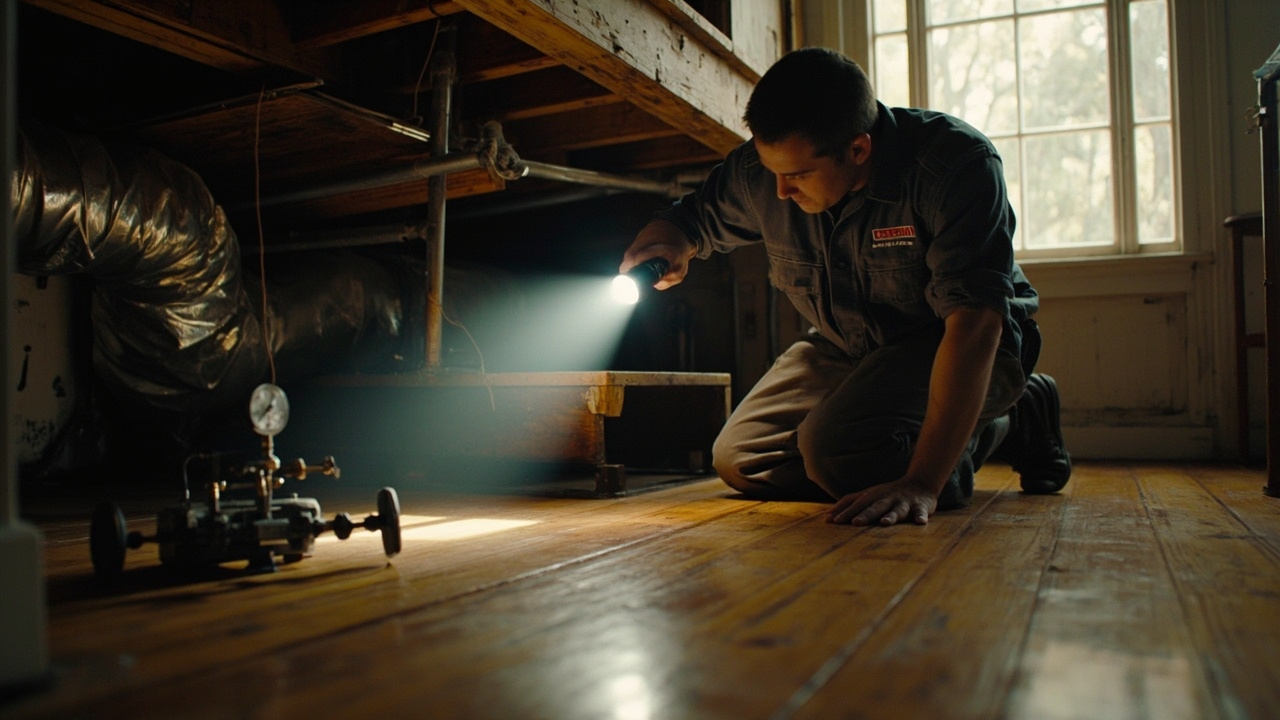
We ask where the weak airflow shows up, one room or the whole house, when you first noticed it, and whether you have seen ice on the outdoor line set. Those answers tell us whether the coil has likely started icing already, which changes how soon we come out. On site, we inspect the filter and return grille first, since a restriction there starves the whole system before the coil or the outdoor unit is even a question.
Diagnosis and your approval
Once the filter and coil are checked, we connect a manometer to the air handler blower to measure total external static pressure against the data plate specifications. That reading reveals whether the restriction originates upstream at the filter or coil, or inside the duct behind the wall or floor. We show you the number and what it means before writing any scope. If it points to a duct correction rather than a simple fix, you see that written out and approve it before we open anything further.
Verification before we leave
Before we leave, the manometer goes back on the air handler and static pressure has to read inside the range the blower data plate rates for that equipment. We walk you through the before and after numbers so the improvement is measured rather than assumed, and you keep that reading on file. If a room was the original complaint, we confirm airflow at that register directly rather than relying on how the rest of the house feels.
Why weak airflow reads differently on older Waco duct systems
A crew that only works newer subdivision duct tends to assume every airflow complaint is a filter or a failing part, because that is what most of their calls turn out to be. Older housing in this city does not always follow that pattern. Pre war construction on raised floors was rarely built with central cooling in mind, so ducts run through crawlspaces and shallow attics that were added later, often with small return grilles that were adequate for the equipment of that era and are not adequate now. A crew unfamiliar with that construction can spend an hour chasing a coil or a capacitor when the real restriction is a return path that was undersized the day it was installed.
Post war ranch stock built on slabs or pier and beam foundations tends to run its ductwork through the attic instead, which changes the failure differently. Attic heat ages flex duct and duct board seals over years of summer runtime, so a seam that held air fine when the house was new can be leaking into the attic by the time a homeowner notices weak flow at a single register. Neither of these is a compressor problem, and neither responds to a part swap.
What changes the outcome is measuring before assuming. A static pressure reading taken at the air handler tells us whether the restriction sits in the equipment or in the duct behind the wall, and that reading holds regardless of when the house was built. Skipping it is what turns a straightforward airflow call into a repeat visit under a different name. The same house age, construction method and ductwork material that make one crew stumble are exactly the facts that guide a crew trained to verify. Duct leakage into unconditioned space wastes the work your equipment does, and finding where it happens requires instruments, not guesswork. That is the only way a single visit solves the problem instead of masking it.
Our page on ac blowing warm air covers that side of the work in more depth.
We install and service major brands like Carrier and register every unit to manufacturer specifications.
What the job looks like from your side
Same day or scheduled visit
You call and describe where the weak airflow is showing up, one vent or every vent, and when it started. That tells us whether ice has likely formed on the coil already or whether the system is still running normally with reduced flow. A system still cooling with weak flow can usually be scheduled. One that has iced over or stopped cooling gets moved up. Either way you get a window before the visit, and if the job ahead of yours runs long, we call to adjust it rather than leave you guessing.
Care around your home
Getting to the air handler and duct usually means access through a closet, an attic hatch, or a crawlspace, so we lay down protection along that path before anything is opened. Tools and any parts removed stay contained rather than spread across the space we are working in. If the coil needs cleaning, runoff is caught rather than left to drip onto insulation or flooring below. When we are done, the access point is closed back up and the area looks the way it did when we arrived.
What moves the cost
The static pressure reading decides most of what this job costs. If the duct can move the air the system needs, the problem lies at the filter, the coil, or a blocked return, keeping the scope small. If static pressure comes back high, the duct itself is the restriction, and correcting a crushed run or an undersized trunk is a bigger job than a repair. Either way you see the reading and the written scope before anything past diagnosis happens, and you approve it before work starts.
Who shows up
A new technician runs a number of airflow calls alongside a lead before working solo, and the lead checks that they read static pressure against the blower data plate correctly before naming a cause. On an older house where the duct runs through a crawlspace or a low attic that was never sized for central air, a second technician looks at the return path before a duct correction gets written into the scope, since guessing wrong there means reopening the same wall twice.
You Have Questions,
We Have Answers
Weak airflow almost always means something upstream of the register is restricting the system, not that the equipment itself has failed. A loaded filter, a dirty or icing coil, or a return grille too small for the equipment are the common causes, roughly in that order of likelihood. In older Waco houses where ducts run through a crawlspace or a shallow attic added after construction, the return path itself is sometimes the original restriction, which a static pressure reading at the air handler identifies directly.
There is no single number to check at a register, since airflow depends on the duct design and equipment for that specific house. What matters instead is the temperature drop across the coil, which normally lands around 15 to 20 degrees between return and supply air, and the static pressure reading against the blower data plate. A drop well outside that range, or static pressure above the rated maximum, points to a restriction worth measuring rather than guessing at from how a vent feels.
Why older Waco duct systems restrict airflow differently
Brook Oaks is a good example of what changes the diagnosis in this part of the city. These are older wood frame houses that had cooling added after they were already built, so the ductwork usually runs under the floor or through a low attic rather than through space designed for it from the start. Return grilles in houses like this were often sized for the equipment and expectations of an earlier era, which means the return path itself can be the restriction long before the filter or the coil is the problem. A static pressure reading here has to be judged against a return that may never have been adequate, not just against whether the filter is clean. Sizing a repair without that context risks fixing a filter and leaving the return exactly as undersized as it was before the call.
Once the static pressure reading and any duct correction are done, we document both the before and after numbers rather than leaving the outcome as a verbal reassurance. That reading is what gets checked first if airflow ever weakens again, since a repeat visit that starts from a known baseline takes less time than one that starts from nothing. On a house where the return path was undersized from the start, that documented number also tells the next technician, whether that is us again or someone else entirely, that the restriction was already identified and corrected rather than something new to chase.
HVAC Services in The Waco Area
Explore our service area and locate Granite HVAC Waco with ease. We're proudly local and serve the surrounding neighborhoods with fast response and honest pricing. Use the map to check our coverage area, or call us and we'll confirm in seconds.
Address:
Granite HVAC Waco, Waco, TX, 76701
Changing a filter on schedule and keeping registers and return grilles clear of furniture and rugs is genuinely a homeowner job. Where it stops is anything behind the blower door or inside the duct itself, since sealing a run or resizing a return means opening construction most homeowners should not be into on their own. If what we find turns out to be a structural crawlspace or attic issue outside mechanical work, we say so on the first visit.
Before you call, know whether the weak airflow is at every vent or just in one room, and when you first noticed it. Check the filter's last change date if you can, and note whether you've seen any ice on the outdoor line set. Knowing roughly how old the system is helps too. Those answers usually tell us whether this needs someone today.
Last reviewed September 2026 by Dale Whitfield, Service manager.